
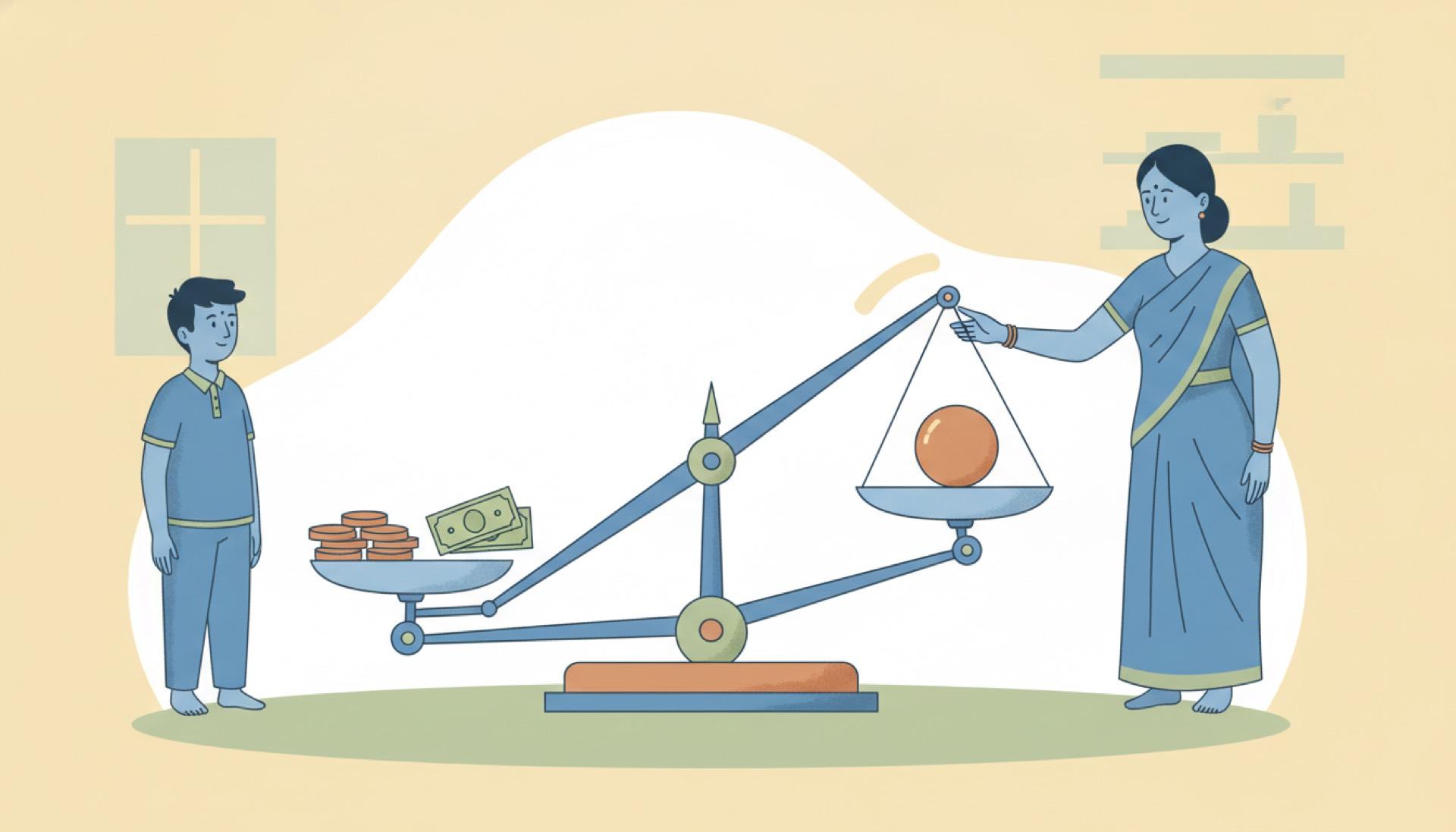
Rebalancing is how you stop a portfolio from drifting away from the plan you set. It means periodically returning your holdings to their target weights, selling a slice of whatever has grown too large and adding to whatever has shrunk. The two common approaches are calendar-based (on a fixed date) and threshold-based (when a holding drifts past a set band).
Left alone, a portfolio does not stay where you put it. The fastest-growing asset keeps taking a bigger share, and your risk rises without you deciding it should.
Rebalancing at a glance
What does rebalancing actually do?
Your target weights come from your asset allocation, the split across equity, debt, gold and cash that suits your goals and risk capacity. Say you chose 60% equity and 40% debt. After a strong year for equity, that slice might swell to 64% or more. You now hold a riskier portfolio than the one you signed up for, purely because you did nothing.
Rebalancing reverses that drift. By selling the portion that has run ahead and buying the portion that has lagged, it forces a buy-low, sell-high action without any prediction about what comes next. That is its real value: the discipline is built into the process, so you are not relying on nerve or a market call.
Calendar rebalancing vs threshold rebalancing
Calendar rebalancing runs on a fixed schedule. You pick a date, once a year is common, and reset to target regardless of what markets are doing. It is simple and easy to automate.
Threshold rebalancing ignores the calendar and watches drift instead. You set a band, say 5 percentage points, and act only when a holding crosses it. This reacts to big moves faster but needs more frequent checking.
Many investors blend the two: they look on a set date but only trade if something has drifted past the band. That keeps the number of transactions, and the costs, down.
A worked example, illustrative only
Assume a ₹10,00,000 portfolio at a target of 60% equity and 40% debt, so ₹6,00,000 and ₹4,00,000. The figures below are hypothetical to show the mechanics, not a forecast of any return.
After a strong equity year, suppose equity has grown to ₹7,50,000 and debt to ₹4,20,000, a total of ₹11,70,000. Equity is now about 64% of the pot, above the 60% target.
| Holding | Target weight | Current value | Current weight |
|---|---|---|---|
| Equity | 60% | ₹7,50,000 | ~64% |
| Debt | 40% | ₹4,20,000 | ~36% |
To reset, equity should be 60% of ₹11,70,000, which is ₹7,02,000, and debt 40%, which is ₹4,68,000. So you trim about ₹48,000 from equity and move it to debt. You have sold a slice of the asset that ran up and topped up the one that lagged, exactly the sell-high, buy-low action, done by arithmetic rather than instinct.
The tax and cost friction in India
Selling to rebalance is not free. Under current rules, gains on equity held over a year attract long-term capital gains tax above an annual exemption, and gains booked within a year are taxed at a higher short-term rate. Debt fund gains are generally taxed at your income slab. There can also be exit loads and transaction charges.
This friction is the main argument against rebalancing too often. Every unnecessary trade hands over tax and costs for a mix that markets may push off target again next quarter. Two ways to cut the drag: route new contributions into the underweight asset so you buy your way back to target without selling, and prefer rebalancing inside tax-advantaged wrappers where a switch does not trigger an immediate tax event.
How often should you rebalance?
No single cadence suits everyone. A yearly check, or a 5-percentage-point drift band, are widely used starting points, not rules. The goal is to rebalance often enough that risk stays close to plan, but rarely enough that tax and costs do not eat the benefit. For most long-term investors, that lands somewhere around once a year.
Related nyvo guides
- Asset Allocation: The Decision That Matters Most: where your target weights come from in the first place.
- Portfolio Diversification, Explained covers spreading risk across and within asset classes.
- Risk Appetite, Tolerance and Capacity – how much drift you can actually stomach.
- Goal-Based Planning 101 is about matching each pot of money to a purpose.
- Saving vs Investing: Which Comes First? – the groundwork before any rebalancing question.
A 60/40 split that has drifted to 64/36 is a bet you never chose to place. Rebalancing is how you unmake it.