
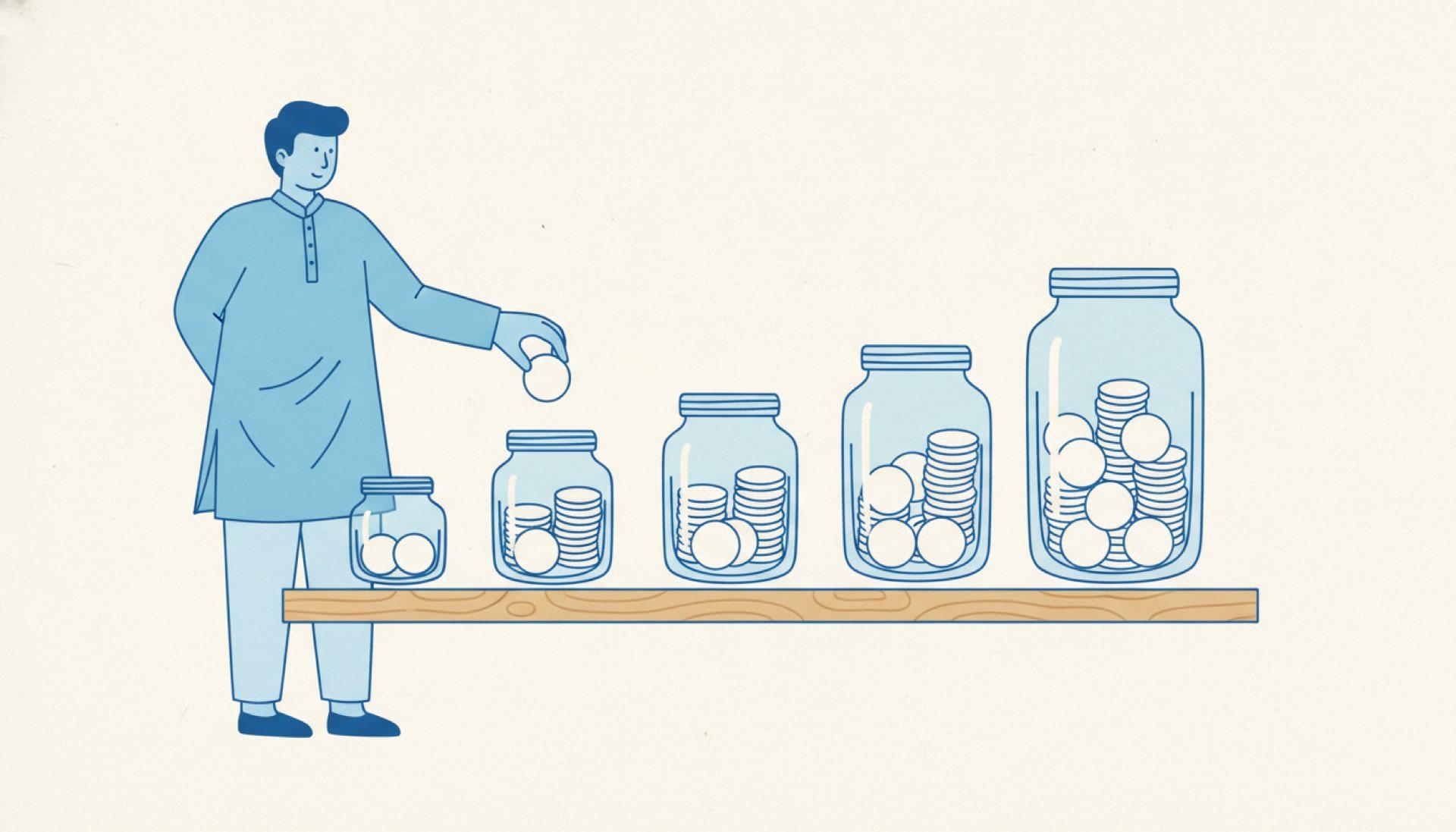
A sinking fund is money you set aside a little at a time for a large, predictable cost that doesn't fall in your monthly budget: an annual insurance premium, Diwali, a car service, a school admission fee. You take the once-a-year amount, divide it by 12, and move that slice into a separate pot every month, so the bill arrives already paid.
Most people think they overspend on daily things: one more Swiggy order, one more auto ride. They don't. Budgets rarely break on the small stuff. They break on the ₹40,000 insurance renewal that lands in one month, or the festival season that adds up to a month's salary.
What a sinking fund actually is
The name comes from old corporate finance. Companies "sank" money aside each year to repay a large debt due far in the future, instead of scrambling for the whole sum on the due date. The household version is the same idea, shrunk to a family's scale.
You are pre-paying a future expense in instalments to yourself. Rather than feel a ₹24,000 car-insurance bill as a shock in March, you move ₹2,000 into a "car" pot every month from April. When March comes, the money is already there. Nothing broke.
The difference between this and "just saving" is that a sinking fund is named and targeted. It has a purpose (Diwali), an amount (last year's spend), and a date (October). That specificity is what makes you actually leave it alone.
Why budgeting the usual way fails
A monthly budget assumes your costs repeat monthly. Most do: rent, groceries, utilities, EMIs. But a real household also carries costs that are annual or seasonal, and those are exactly the ones a monthly budget has no line for:
- Insurance premiums. Car, bike, health and term, often billed once a year.
- Festivals. Diwali, Eid, Christmas, Rakhi: gifts, clothes, sweets, travel.
- School and college. Admission, annual fees, uniforms, books.
- Vehicle upkeep. The yearly service, new tyres, pollution and registration renewals.
- Home. Annual maintenance, a repaint, an appliance that dies on schedule.
Each is predictable. You know the health premium renews every year. You know Diwali is in autumn. Pretending these are "surprises" is what forces the credit card out, or raids the emergency fund for something that was never an emergency.
How to set up a sinking fund
Three steps, once a year:
- List every lumpy cost you know is coming. Walk through last year's bank and card statements. Write down each irregular bill and roughly what it cost.
- Divide each annual amount by 12. That's your monthly contribution for that category. Add them up; the total is the monthly gap your old budget never had a line for.
- Automate one transfer. On salary day, auto-transfer the combined amount into a separate savings account or a liquid fund kept apart from daily spending. One transfer, many virtual pots.
Then you simply withdraw from that pot when each bill lands. You are not finding money in a panic; you are spending money you already parked.
Example sinking-fund categories
Illustrative figures only; use your own numbers from last year's statements.
| Category | Annual cost (estimate) | Monthly slice |
|---|---|---|
| Car + bike insurance | ₹24,000 | ₹2,000 |
| Health insurance premium | ₹36,000 | ₹3,000 |
| Diwali + festivals | ₹30,000 | ₹2,500 |
| School annual fees | ₹60,000 | ₹5,000 |
| Car service + tyres | ₹18,000 | ₹1,500 |
The point isn't the exact figures. It's that around ₹14,000 a month, moved on schedule, replaces five nasty shocks a year.
A sinking fund is not an emergency fund
The test is simple: can you name the expense and its rough date? Diwali, the March insurance renewal, June school fees are all known, all sinking-fund. A hospital admission you can't predict belongs to the emergency fund. One protects your budget; the other protects your survival.
Where to keep a sinking fund
For money you'll need within the year, safety and access beat returns. A separate savings account works and keeps the money visibly "not for spending". A liquid or short-duration debt fund can earn a little more while staying accessible in a day or two. The same logic that decides where to keep an emergency fund applies here: avoid locking a sinking fund into a long fixed deposit or anything with market risk. The whole point is that the cash is there on the date you need it.
The payoff is a boring year
A sinking fund doesn't make you richer on paper. It makes your financial life boring – and boring is the goal. The renewal that used to wreck a month becomes a non-event. You stop reaching for the credit card for things you always knew were coming. A budget only truly holds when it has already made room for the year's big bills, one small slice at a time.
Related nyvo guides
- The 50/30/20 Budget, Reworked for Indian Households – the monthly framework your sinking-fund slices slot into.
- Emergency Fund: How Much Do Indian Families Actually Need? – the other pot, for the costs you can't name in advance.
A sinking fund spends the same money a little earlier, so the year's big bills stop arriving as shocks. In the table above, that is ₹14,000 a month set against five renewals and seasons whose dates you already know.