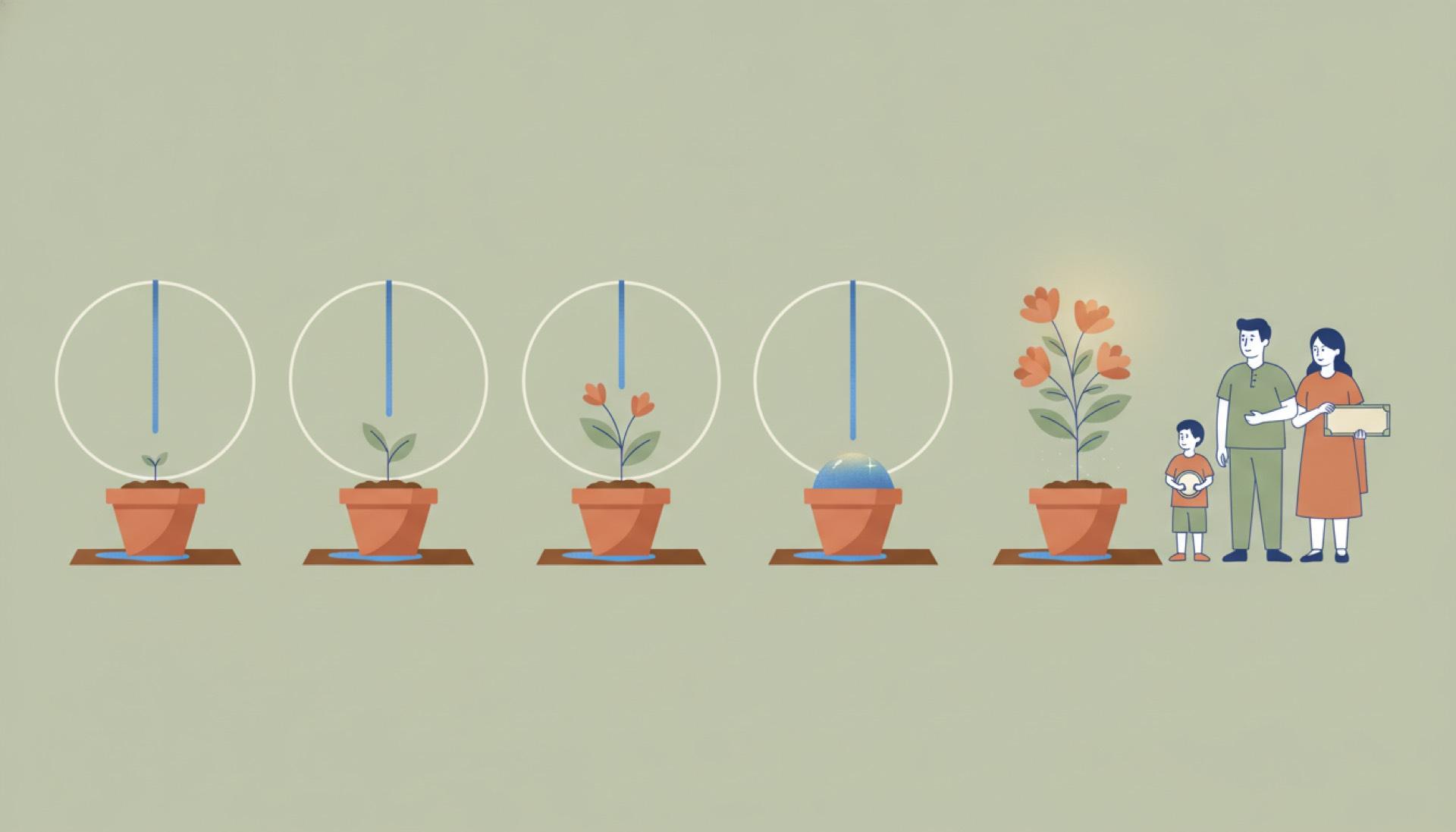

The best age to teach a kid about money is younger than you think and the best method is more practical than you think.
Indian parents often default to either (a) shielding kids from money entirely ("don't worry about it") or (b) lecturing about money in abstract terms. Both fail. What works is age-appropriate, hands-on, small-stakes practice.
Here's the playbook.
Ages 5–7: Scarcity and choice
The core concept: there isn't infinite money; spending on X means not spending on Y.
Practical moves:
- Introduce small pocket money (₹10–50/week). Doesn't matter what the amount is; what matters is that it's fixed and reliable.
- "Shopping games": give them ₹200 at a grocery store and let them pick their own snacks. Watch the trade-offs happen.
- Three-jar system: Save, Spend, Share. Label them. Every pocket money gets split three ways (let them choose the split at first, then slowly standardize).
What to skip: interest, compounding, stocks. Too abstract.
Ages 8–10: Earning and patience
The core concept: money is earned; waiting makes money grow.
Practical moves:
- Introduce earning for specific extra chores (not routine ones; those are family duties). ₹20 for washing the car, ₹50 for helping organize the kitchen.
- Introduce a "match." If they save ₹500 in their save-jar, you add ₹100. This is a tangible first taste of what interest feels like.
- Read One Grain of Rice by Demi. It's the best introduction to exponential growth any parent can use.
First bank account
Around age 8 is a good time to open a minor savings account (joint with parent). Many Indian banks now offer them with debit card under parental supervision. Tangible proof that "saving" is a real place with real numbers.
Ages 11–13: Interest and inflation
The core concept: money in a savings account grows slowly, and inflation makes things more expensive each year.
Practical moves:
- Start explaining interest with their own bank account. Show them the statement. "This ₹30 came from nothing. This is interest."
- Teach inflation with a real example: "This Coca-Cola cost ₹10 when I was your age. Now it's ₹40. That's why we can't just sit on money."
- Let them plan a small goal. "You want a bicycle that costs ₹8,000. You have ₹2,000. How long until you get there if you save ₹500/month? What if you save ₹1,000?"
- Teach credit card basics. Use your own card. Show the statement. Explain interest charges if unpaid.
Sukanya Samriddhi for daughters
SSY can only be opened before the girl turns 10. That is a hard statutory eligibility rule, so at 11–13 the window has closed. If you opened one earlier, keep contributing: 8.2% tax-free with an 80C benefit on up to ₹1.5 L a year is still among the best long-term rates available. If you missed the window, use PPF in her name or an equity mutual-fund SIP via a minor account for the same goal instead.
Ages 14–16: Investing and taxes
The core concept: money can work for you, not just sit. Plus, the government takes its cut.
Practical moves:
- Introduce mutual funds. Use a real, simple explanation: "A mutual fund is a big pot of money from many people that a manager invests in many companies so we don't have to pick just one."
- Start a small SIP in their name (through you as guardian). ₹500/month is plenty. Show them the statement every 6 months.
- Explain compounding. Calculator time. "If you SIP ₹1,000/month from now until you're 40, what will you have?" (Spoiler: ~₹18 lakhs at 11% CAGR. Most 14-year-olds are stunned.)
- Introduce the idea of taxes. Take them through a salary slip. "This is gross. This is tax. This is net."
First mutual fund
Age 15–16 is perfect for a ₹500–1,000/month SIP in the kid's name. They feel ownership. They watch a real number grow. They understand market drawdowns when you sit them down during the next correction.
Ages 17–18: Independence and risk
The core concept: you are responsible for your own money soon. Here's how adults actually do it.
Practical moves:
- Open their own bank account (independent, no parent signatory if legally possible at 18).
- Introduce UPI safety: never scan QR codes to receive money, only to pay. Explain common scams.
- Walk through the basic budget categories they'll need in college: rent, food, transport, entertainment, savings.
- If they have a summer internship income, make them save 30% of it. Show the auto-SIP mechanism.
- First credit card discussion. The "pay 100% every month" rule. Never carry a revolving balance.
First stock or ELSS
If your teen is showing real interest, let them pick one individual stock or ELSS fund and invest ₹5,000. Watching one stock move teaches volatility in a way no textbook does.
What absolutely NOT to do
- Guilt-spend. "I worked hard for this money" discussions around every purchase. Kids absorb money anxiety, not money skill.
- Hide money stress. If the family is going through a tight patch, age-appropriate transparency is better than pretending nothing's wrong.
- Micromanage their pocket money. The point is to make mistakes with ₹50. So they don't make them with ₹50,000 at age 30.
- Compare constantly with cousins. "Look at Aarav, he saved half of his pocket money." Money behaviour is private. Don't weaponize it.
- Avoid the topic entirely. 60% of Indian children never have a single financial conversation with their parents. That's the real tragedy.
The tax-advantaged options for children
Three instruments every Indian parent should know:
1. Sukanya Samriddhi Yojana (SSY): daughters only, up to age 10 to open. 8.2% tax-free, among the highest long-term small-savings rates. Contribute up to ₹1.5 L/yr (counts toward 80C). Use the SSY calculator.
2. PPF in child's name: both sons and daughters. 7.1% tax-free. ₹1.5 L/yr limit (shared across family's 80C). 15-year lock-in.
3. Equity MF in child's name (minor account): you as guardian. SIP as low as ₹500/month. This is where real wealth compounds over 15+ years. Eventually reassign when the child turns 18.
Related nyvo guides
- The 50/25/15/10 Budget – the budget they'll need to live once they're earning.
- New Baby: 10 Money Moves in the First 90 Days – the starting point for any parent.
- SSY Calculator – model the government's best long-term saving scheme for a girl child.
The most underrated lesson
Show them your real monthly budget. At age 15, sit them down once and walk through your actual income, your actual expenses, your actual savings rate. No numbers fudged.
It's the single most effective financial-education hour of their life. It demystifies money. It models honesty. It prepares them for real adulthood.
Most Indian parents never do this. Be the exception.
Action list
- If you have a kid under 10, start the three-jar system this weekend.
- If you have a kid 11–13, open their own savings account if you haven't.
- If you have a kid 14–18, set up a ₹500 SIP in their name this month.
- At age 18, do the "full transparency" budget walkthrough.
Small, consistent, practical. That's the whole playbook.