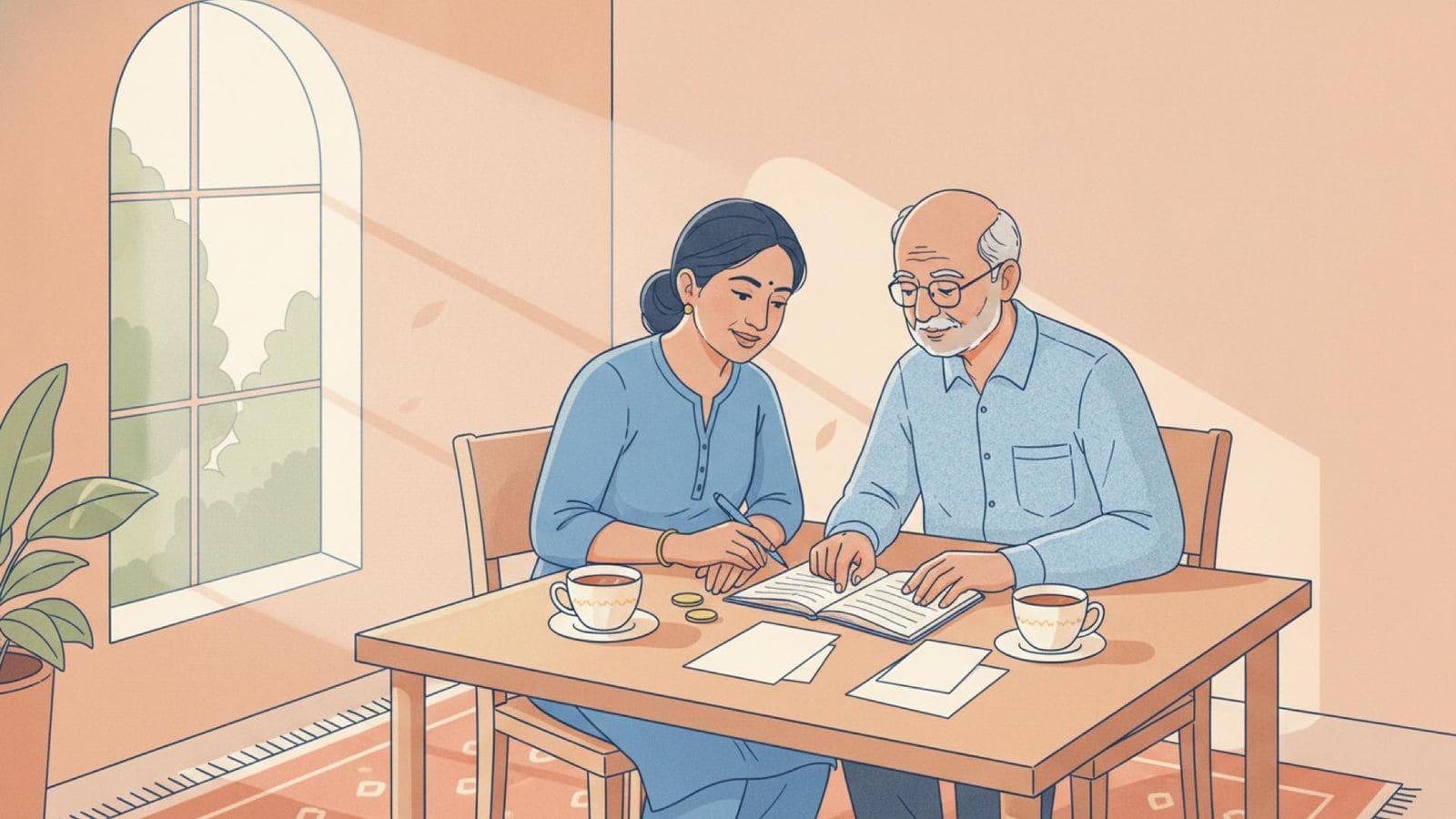
You spend 18 months planning the wedding. Most couples spend 18 minutes planning the money.
Here's the work that actually matters, the conversations, the documents, and the protection layer, that you should close before (or during) the first 90 days of marriage. It's a boring list. It's also the list that decides whether the first big money surprise in the marriage is an argument or a plan.
Step 1: Have "The Conversation"
Before any account changes, you need an honest exchange on six topics. Don't do this over dinner. Block two hours, sit with a notebook, write it down. Revisit quarterly.
- Income & obligations. Actual take-home. Loans, student, credit card, personal, family. EMIs. Rent. Parental support commitments, both sides.
- Savings & investments. Current mutual fund folios, FDs, equity holdings, employer stock, PF balance.
- Insurance. Health policies (both personal and employer). Term policies. Motor. Lapses.
- Credit health. CIBIL score. Any defaults. Any co-signed loans.
- Money values. Risk tolerance, attitude to debt, spending vs saving defaults, views on financially helping family.
- Goals. Home, kids, travel, retirement, parents' support, in years, not "eventually."
No surprises on the wedding day is the promise. Disclosure of financial baggage is how you keep it.
Step 2: Decide your account architecture
There are three working models. None is "right." The one you pick is the one both of you actually maintain.
Model A, Fully joint. One pool. All income in, all expenses out. Requires high alignment on spending.
Model B, Fully separate, proportional contribution. Each partner contributes to a shared "household" account in proportion to income. Separate accounts for personal spending.
Model C, Hybrid. Both keep salary accounts. A single joint account for shared expenses and shared savings. Auto-transfers monthly.
Model C is what most nyvo couples choose. It preserves autonomy, enforces shared goals, and makes divorce, statistically relevant, less paperwork-heavy.
Step 3: Update nominees everywhere
This is the most-skipped step and the highest-consequence one. Go through each of these within 60 days of the wedding:
- Mutual fund folios. Each AMC, each folio. Log into CAMS/KFintech or use the MF utility for bulk update.
- Equity demat account. NSDL/CDSL nominee.
- EPF / PF. Via Unified Member Portal.
- PPF. Form F at the post office or bank.
- NPS. Via eNPS.
- Bank accounts. Both savings and FDs.
- Life insurance policies. Both term and endowment.
- Health insurance. Both personal and employer group plans.
Nominee ≠ heir. A nominee is a receiver/custodian. For asset succession, you need a will (step 5). But nominee updates prevent immediate cash-flow paralysis at the worst possible moment.
Step 4: Fix the insurance layer
Marriage changes your insurance math in three ways.
Term cover. Your financial dependents just increased. If your spouse earns less than you (or the difference is expected to widen with children), your term sum assured should rise to 15–20× your annual income. Buy additional term if needed. Premiums are cheapest when you're young and healthy.
Health cover. Employer cover is not enough. A family floater (you + spouse, later + children) with ₹10–25 L base cover plus a super-top-up is the standard. Waiting periods on maternity benefits are usually 2–4 years, buy now, not when planning a baby.
Existing ULIP / endowment policies. Review them now. If you were sold an "LIC policy" at age 23 by an uncle, making it paid-up is often the better call than continuing. Don't surrender emotionally, run the numbers.
Step 5: Write (or update) your will
Unpopular topic, essential document. If you die intestate in India, succession follows the Hindu Succession Act (or the applicable personal law), which may not match what you'd actually want, especially if you want to split assets between spouse, parents, and siblings in specific proportions.
A one-page registered will costs a few thousand rupees and takes two hours; how to make a will in India walks through the steps. Get it done.
Step 6: Spreadsheet the combined net worth
Once a quarter. Open a Google Sheet. List:
- Every bank account and its balance.
- Every mutual fund folio and its current value.
- Every demat holding.
- Every FD/RD.
- Every PF / PPF / NPS balance.
- Property (current estimated value).
- Liabilities (home loan, personal loan, credit card revolving).
Total assets minus total liabilities = net worth. Repeat in 12 months. Watch it move.
Couples who track this stay aligned. Couples who don't discover the gap 10 years later.
Step 7: Align on the joint goals
Once you have the conversation, the accounts, and the spreadsheet, goals become tractable. The big four for married Indian couples:
- Emergency fund: 6 months of household essential expenses, in a liquid fund.
- Down payment for home: if planned in 5–10 years, mix of hybrid + balanced advantage funds.
- First child education fund: starts the day you start trying. SIP into equity + SSY if daughter.
- Retirement: earliest you start, biggest compounding. 10% of joint income, rising yearly.
SIP calculator helps you size each goal's monthly commitment against target amount and years.
The 30-day checklist
Week 1. The Conversation. Write down the six topics.
Week 2. Agree on account architecture. Open the shared account. Set up auto-transfer.
Week 3. Nominee updates everywhere. One list, one afternoon.
Week 4. Term cover top-up applied. Family floater health cover applied. Wills drafted.
Month 2. Start the combined net worth spreadsheet. Align on top three joint goals. Set up SIPs.
Month 3. First quarterly money review. Make it a recurring calendar event.
Related nyvo guides
- New Baby: 10 Money Moves in the First 90 Days: the next major life event after marriage for most couples.
- Term vs Whole Life: The 60-Second Primer: the protection decision most newly-married couples get wrong.
- Goal-Based Planning 101: build the joint plan.
The real promise
The goal isn't to become a finance-obsessed couple. It's to never have the conversation "wait, how do we pay for this?" in a moment of stress.
If you'd like an outside advisor to run through this with you together, book a free consultation. We've done it with hundreds of nyvo couples. It's unexpectedly enjoyable.