
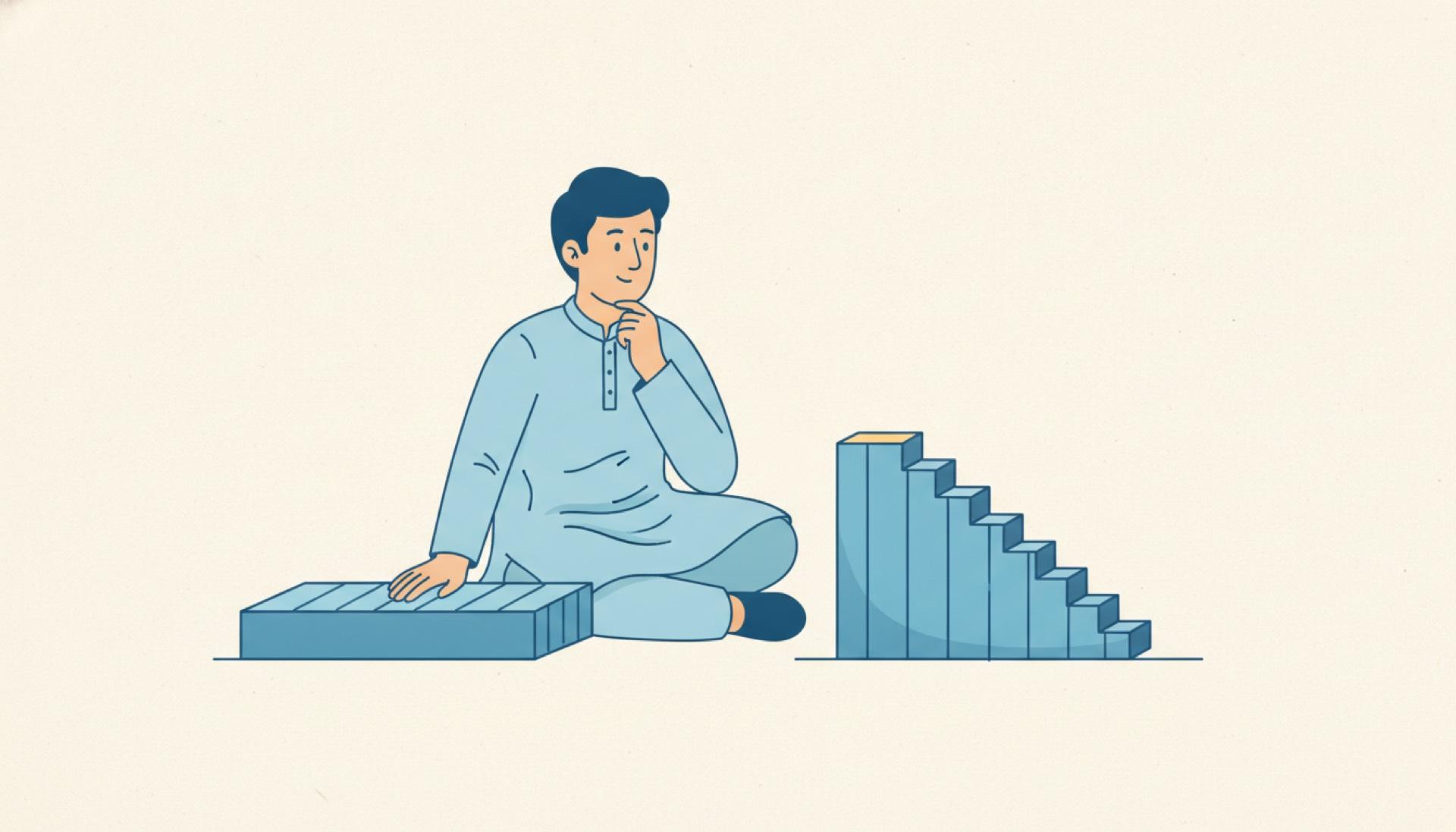
A flat interest rate charges interest on your full original loan amount for the entire tenure, even as you steadily repay it. A reducing rate charges interest only on the balance you still owe. A flat rate always costs far more than the same-numbered reducing rate: a 10% flat loan works out to roughly 18% on a reducing basis.
The flat number looks smaller, so it wins the advertisement. That is exactly why it is worth understanding before you sign.
Flat vs reducing at a glance
What is a flat interest rate?
A flat rate is calculated on your original principal for the whole tenure. Borrow ₹5,00,000 at 10% flat for five years and you are charged 10% of ₹5,00,000 every year (about ₹2,50,000 of total interest) regardless of how much you have already paid back.
The trap is buried in that "regardless". By year four you may owe the lender very little, yet you are still paying interest as if you owed the full ₹5,00,000. You keep paying for money you no longer have.
What is a reducing balance rate?
A reducing-balance rate (also called a diminishing rate) charges interest only on the outstanding balance. As each EMI cuts your principal, the interest portion shrinks with it. This is how home loans and most personal loans work.
Same ₹5,00,000, same 10%, but reducing. Because the balance falls every month, the total interest is far lower than the flat version. For the borrower, this is the fairer and cheaper structure.
Flat vs reducing: the real cost, side by side
Here is the conversion that lenders would rather you did not do. These figures are illustrative and assume a typical three-to-five-year loan; the exact equivalent shifts with tenure.
| Advertised flat rate | Approximate reducing-rate (APR) equivalent |
|---|---|
| 5% flat | ~9% reducing |
| 8% flat | ~14–15% reducing |
| 10% flat | ~18% reducing |
| 12% flat | ~21–22% reducing |
| 15% flat | ~27% reducing |
The multiplier sits around 1.8× for a three-to-five-year loan, is highest around two-to-three-year loans, and eases off for both shorter and longer ones. So a two-wheeler "at just 11% flat" can be a 20%-plus loan in reducing terms.
Why does a flat rate cost almost double?
Because you are charged on money you have already returned. On a reducing loan, once you have repaid half the principal, you pay interest on only the remaining half. On a flat loan, you pay interest on the whole original amount until the last EMI.
Illustrative worked example on that ₹5,00,000 car loan over five years:
- At 10% flat, total interest is about ₹2,50,000, and the EMI is roughly ₹12,500.
- An EMI of ₹12,500 on ₹5,00,000 over five years is what you would pay on a reducing rate of about 17–18%.
Same monthly cheque, wildly different headline. The flat "10%" and the reducing "18%" are the same loan wearing different labels.
How to compare two loans honestly
Never compare a flat rate against a reducing rate at face value; you will always pick the wrong one. Instead:
- Ask for the APR. The Annual Percentage Rate expresses the true annual cost on a reducing basis, including most fees. It is the one number that makes two loans comparable.
- Ask for the total amount payable. Principal plus all interest and charges over the full tenure. This cuts through both rate structures.
- Compare the EMI and tenure together. A lower EMI stretched longer can still cost more overall.
Where you'll still see flat rates in India
Flat rates cluster where the loan is small, quick, or sold at the point of purchase: car and two-wheeler loans, consumer-durable finance, some gold loans, and informal lending. The pitch is speed and a low-looking number, and both work because few borrowers stop to convert.
You are not being cheated when a flat rate is disclosed; it is a legitimate structure. You are only being cheated by your own arithmetic if you compare it against a reducing rate without converting first.
Related nyvo guides
- Loan Prepayment: How to Do It Right explains how paying early cuts interest, and why it saves far more on a reducing-balance loan.
- How to Improve Your CIBIL Score in India: a stronger score gets you a lower reducing rate in the first place.
- Saving vs Investing: Which Comes First? covers where a cleared, cheaper loan frees up money to go next.
A flat rate is not a scam, but it is a disguise. Strip it off, convert it to a reducing rate, and compare every loan on that true number. The cheapest-looking loan and the cheapest loan are rarely the same one.