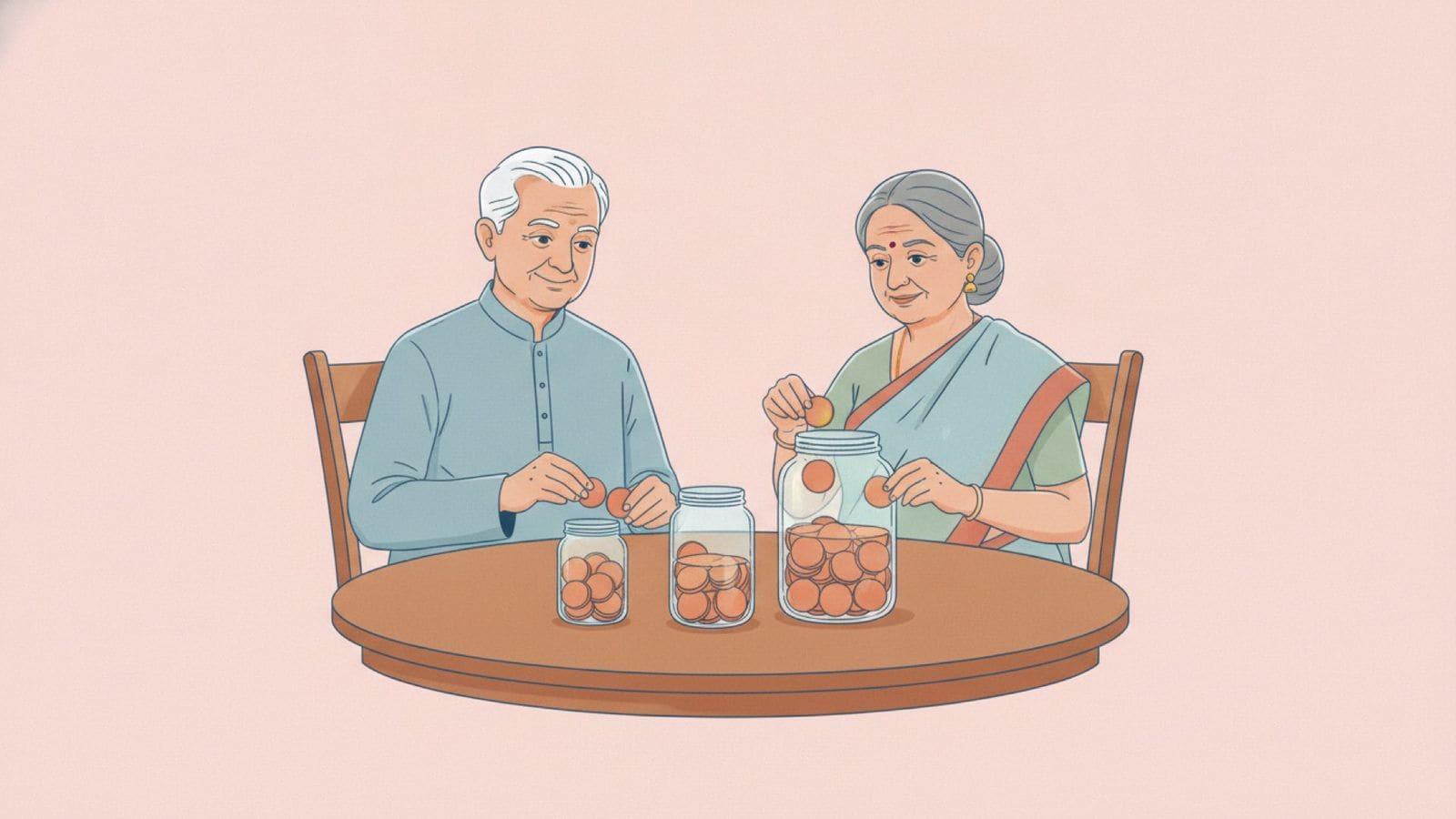

The Employees' Provident Fund (EPF) is a retirement savings scheme for salaried workers, run by the Employees' Provident Fund Organisation (EPFO). You contribute 12% of your basic pay plus dearness allowance each month, your employer adds a matching 12%, and the balance earns a rate the EPFO sets once a year, currently 8.25%. Held for five years, it is tax-free.
For most salaried Indians, EPF is the first and largest retirement account they will ever own, and it keeps building in the background whether or not they think about it.
EPF at a glance
How does EPF work?
If you work at an establishment with 20 or more employees and earn within the covered range, EPF is usually mandatory. Each month 12% of your basic pay plus dearness allowance leaves your salary and goes into your EPF account, and your employer contributes the same 12% again.
The two halves are not treated identically. Your full 12% goes into EPF. Of the employer's 12%, a slice of up to 8.33% is routed to the Employees' Pension Scheme (EPS), but that slice is capped at 8.33% of ₹15,000, about ₹1,250 a month. On a basic pay of ₹15,000 or less that leaves 3.67% for your EPF; on higher pay the EPS share is frozen at the cap, so more than 3.67% reaches EPF. Both parts compound at the EPFO rate.
What return does EPF pay?
The EPFO rate is set once a year, not every quarter. The Central Board of Trustees recommends a rate, the government approves it, and it is then credited to member accounts. The latest declared rate is 8.25%, among the higher administered rates available, though it too can move from year to year.
Because the rate is annual rather than quarterly, EPF does not react to short-term rate swings the way a bank deposit does. What you give up in flexibility, you gain in a steady, sovereign-backed rate on a growing balance.
How is EPF taxed?
EPF is an EEE instrument in the ordinary case: the contribution qualifies for Section 80C, the interest is untaxed as it builds, and the maturity is tax-free, provided you complete five years of continuous service. Service counts across employers when you transfer the account rather than withdrawing between jobs.
Two exceptions matter. Withdraw before five years and the amount generally becomes taxable. And since Budget 2021, interest on your own contributions above ₹2.5 lakh in a financial year is taxable, even while the rest of your EPF stays exempt. That ₹2.5 lakh ceiling is what makes very high provident-fund contributions less tax-efficient than they once were.
What is a UAN, and why does it matter?
The Universal Account Number (UAN) is a permanent 12-digit number that ties together every EPF account you hold across jobs. When you switch employers, you keep the same UAN and transfer the balance, rather than withdrawing and restarting.
This is more than admin tidiness. Transferring instead of withdrawing keeps your five-year clock running and lets the corpus keep compounding. Withdrawing at each job change resets the clock and can make the payout taxable, a common and avoidable leak.
Can you take money out before retirement?
EPF is built for retirement, but it is not fully locked. Since EPFO's October 2025 changes, partial withdrawals fall into three categories: essential needs (illness, education, marriage), housing, and special circumstances. You need at least 12 months of service, and 25% of the balance always stays in the account, so in practice up to 75% can come out. Leave a job and the same 75% is available at once, with the last 25% released after 12 continuous months out of covered work. EPF withdrawal rules if you retire early covers the details.
You can estimate how your balance grows over a career with the EPF calculator.
Related nyvo guides
- EPF Withdrawal Rules If You Retire Early – the 55 rule, the 12-month wait and the 25% that stays in.
- Voluntary Provident Fund (VPF): How It Works – how to top up EPF beyond the standard 12% at the same rate.
- EPF vs PPF: What's the Difference? – the salaried-automatic fund against the do-it-yourself one.
- Section 80C: The ₹1.5 Lakh Deduction Explained – the deduction your EPF contribution already fills part of.
EPF is the rare retirement plan that works even if you ignore it. The one habit that matters is not withdrawing it at every job change. Transfer it, keep the clock running, and let 24% of your basic pay compound tax-free for decades.