The Fund Category That Promised Everything and Explained Nothing
₹21,000 crore rushed in on a promise of equity-style tax and debt-style calm – then investors started asking what they were actually holding.
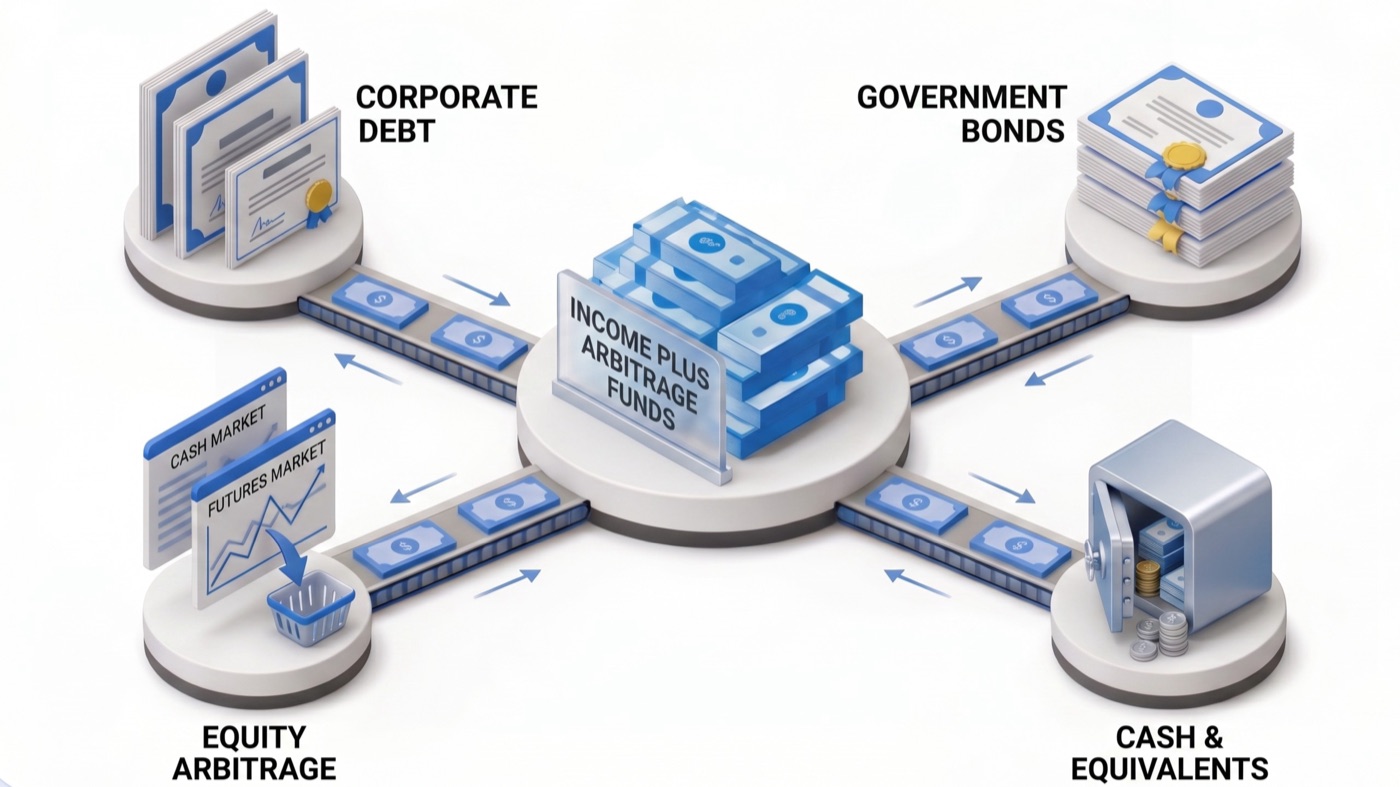
In 2024, a new category of debt mutual funds launched with a pitch that sounded almost too clean: equity-like tax treatment, debt-like stability, and a hedge against the market's sharper swings. Fund houses called it income plus arbitrage. Investors called it, within two years, the fastest-growing corner of the debt fund market – nine schemes became 22, and ₹21,000 crore poured in through 2025 alone.
Then, this year, the same investors pulled roughly ₹2,000 crore back out.
Nothing about the funds' mandate changed between those two moments. What changed was that the promise met the portfolio – and the portfolio turned out to be harder to explain than the pitch.
What's actually inside
An income plus arbitrage fund is a fund of funds. It holds at least 35% in an arbitrage fund – the part that captures the spread between cash and futures prices – and parks the rest across a mix of debt funds, which can range from AAA-rated government paper to corporate bonds. That 35% threshold isn't cosmetic. It's the line that lets the fund qualify for equity-style long-term capital gains treatment: 12.5% tax if held two years, instead of being taxed at the investor's income slab like a regular debt fund.
For someone in the 30% bracket parking money for two to three years, that's a real number. It's also, on paper, the entire reason the category exists.
The incentive behind the innovation
Debt mutual fund taxation changed in 2023, and every debt-oriented AMC lost the same lever overnight – indexation benefits that used to soften the tax bill on multi-year holdings. Income plus arbitrage funds are the industry's answer: a structure engineered specifically to reopen a tax door that regulation had closed. The 35% arbitrage allocation is not an investment view. It's a compliance threshold, built to unlock a rate.
That's a rational response from the fund houses. It also means the product was designed backward – starting from the tax outcome, and building a portfolio to justify it.
Why the category resists comparison
Here's where it gets messy. Two funds can both call themselves “income plus arbitrage” and hold almost nothing in common. Kotak's version keeps about 20% in short-duration debt and 30–32% in corporate bond funds. ICICI Prudential's version holds 13% in a gilt fund investing in government securities instead, with a similar corporate-debt allocation but a different quality and duration mix underneath it. Some fund houses have gone further and split the category itself – HDFC runs both an “active” fund of funds, where the manager actively picks and rotates the underlying debt funds, and an “omni” version, which can also hold index-based debt funds.
| Fund house | What sits underneath |
|---|---|
| Kotak | About 20% in short-duration debt; 30–32% in corporate bond funds |
| ICICI Prudential | 13% in a gilt fund (government securities); similar corporate-debt allocation with a different quality and duration mix |
| HDFC | Two versions – an “active” fund of funds where the manager picks and rotates the underlying debt funds, and an “omni” version that can also hold index-based debt funds |
None of this shows up in a fund's name. An investor comparing two income plus arbitrage schemes on paper is often comparing two structurally different bets that happen to share a tax bracket.
Where memory and marketing diverge
Money moved into this category the way money usually moves into anything positioned as “tax-efficient and stable” – fast, and mostly on the promise rather than the mechanics. Inflows peaked near ₹5,179 crore in one month in 2025. Nine months later, outflows hit ₹2,708 crore in a single month, before settling to a smaller net inflow of ₹547 crore.
The returns don't fully explain the reversal. Income plus arbitrage funds gained 5.7% over the past year – behind arbitrage funds alone (5.73%), behind short-duration debt (5.33% but close), and meaningfully behind money market debt funds (6.22%).
| Category | 1-year return |
|---|---|
| Income plus arbitrage | 5.7% |
| Arbitrage funds | 5.73% |
| Short-duration debt | 5.33% |
| Money market debt | 6.22% |
Respectable, not remarkable. But the sharper trigger looks less like a returns story and more like an understanding story: investors bought a tax benefit and a vague sense of safety, then discovered they couldn't easily tell what risk they were actually holding once the mid-caps of the debt world – corporate bonds and development loans – started making up a third of the fund.
Versus the two obvious alternatives
Strip the branding away and the real question isn't should I buy this fund. It's why this, and not a fixed deposit or a plain arbitrage fund – the two products this category is quietly priced against.
The answer changes depending on which one it's replacing, and the difference is almost entirely a tax story.
Against a fixed deposit, the pitch is at its strongest. FD interest is taxed every year, at your slab rate, and no holding period ever changes that – someone in the 30% bracket hands back nearly a third of the interest annually.
An income plus arbitrage fund defers the entire tax bill to redemption and settles it at 12.5%, as long as the two-year mark is crossed. For higher-bracket investors, that gap can tip the post-tax outcome in the fund's favour even when the pre-tax return is similar or a touch lower – which is exactly the profile advisers say the category was built for.
Against a plain arbitrage fund, the case wobbles. A regular arbitrage fund already enjoys equity taxation – and it reaches the same 12.5% LTCG rate after one year, not two.
On this year's numbers it also earned slightly more (5.73% against 5.7%), while carrying less structure to worry about: no separate debt sleeve, so no extra credit or duration risk riding underneath.
What's left in favour of income plus arbitrage is convenience – a longer lock-in with debt and arbitrage blended in a single fund, instead of assembling that mix yourself. A convenience trade, not a returns trade.
| Product | How the gain is taxed | Holding for that rate |
|---|---|---|
| Fixed deposit | Interest taxed every year at your slab rate – up to 30% – with no LTCG treatment, however long you hold | None available |
| Income plus arbitrage | Entire gain taxed once, at redemption, at 12.5% | Two years |
| Plain arbitrage fund | Equity taxation – the same 12.5% LTCG rate | One year |
Put plainly: against fixed deposits, this category has a genuine tax-bracket argument. Against plain arbitrage funds, it has – on this year's returns, at least – something closer to a marketing story than a numbers story.
So who is this actually for
Strip away the marketing and the category narrows fast. Advisers who use these funds tend to reserve them for a specific profile: investors in the 25–30% tax bracket or higher, parking money for a defined two-to-three-year window, who would otherwise have defaulted to a plain debt fund and paid slab-rate tax on the gains. Below that bracket, the tax saving shrinks enough that it stops being the deciding factor – and at that point, a simpler, more transparent debt or money market fund often does the same job with fewer moving parts to misread.
A few checks worth running before buying in, based on what's actually driven the flows so far:
Check the horizon
The tax benefit only kicks in past two years. Redeem earlier and you're paying regular slab-rate tax on a fund that took on more complexity for nothing in return.
Read the underlying mix, not the name
“Income plus arbitrage” says almost nothing about whether you're holding government paper or corporate bonds and development loans. Two funds in the same category can carry meaningfully different credit and duration risk – that difference is where the real risk sits, not in the arbitrage sleeve.
Compare the return, not just the tax rate
A lower tax rate on a mediocre pre-tax return isn't automatically better than a higher tax rate on a stronger one. At 5.7% average annual returns, some of these funds are already trailing money market debt funds before tax is even applied.
Don't mistake “fund of funds” for “diversified and safe”
The structure adds a layer of manager discretion – which debt funds to hold, and when to rotate them – on top of the risks already inside those underlying funds. That's an added judgment call investors are trusting blindly, often without realizing it's there.
If the honest answer to “what would I do with this money otherwise” is “leave it in a standard debt fund for two-plus years,” the tax math can genuinely work in your favour. If the honest answer is “I'm not sure, but this sounded safer,” that uncertainty is worth resolving before the money goes in – not after the first bout of underperformance forces the question.
The long-term implication
This is a structural pattern worth watching beyond this one category. Every time regulation closes a tax advantage, the industry's next move is rarely a simpler product – it's a more layered one, wrapped just tightly enough to requalify. Income plus arbitrage funds aren't unique in this; they're an early, visible example of a pattern that will likely repeat as tax rules keep shifting: products engineered around a rate, sold on stability, and held together by a structure most buyers never fully unpack.
And for a category that's barely three years old, the honest answer to “what am I actually holding” still depends entirely on which fund house's version you picked – a level of due diligence most retail money was never built to do at the point of purchase.
Category flow and return figures are point-in-time and were as reported when this was written (21 August 2026); one-year returns are category averages, not any single fund’s. The fund-house allocations described are as disclosed at that date and change as managers rotate the underlying funds – read the current factsheet before relying on any of them. Tax treatment reflects the equity-oriented threshold and the 12.5% long-term rate applying past two years; rules change, and your own position depends on your bracket and holding period. Past performance does not indicate future returns. This is research and general information under INA000022172, not advice to buy, sell or hold any fund named here.
Now in the nyvo app
Plan it for real in the nyvo app.
Goals, projections, fund grades and your whole family's money – in one place. Free. SEBI-registered.
Tools to try
Run the numbers yourself.
Free calculators that go with this issue. Built for Indian rules (rupees, inflation, tax regime).
- LTCG Calculator India – 2024 Capital Gains Rates
Long-term capital gains tax on equity, debt, gold and property in India, with the 2024 Budget changes built in: 12.5% on equity beyond ₹1.25L.
- Mutual Fund Tax Calculator India – Equity, Debt & Gold Rules
Capital-gains tax on a mutual fund sale under current rules: 20% / 12.5% on equity with the ₹1.25 lakh exemption, slab rate on post-2023 debt.
- FD Calculator India – Fixed Deposit Maturity & Post-Tax Return
Fixed deposit maturity with quarterly compounding, the cumulative-vs-payout difference, and what the return actually is after tax at your slab.
← Newer issue
Two Philosophies of Asset Allocation – and What Works Best in India
Older issue →
The Cost of Global Investing: You Pay Going Out. You Pay Coming Back.
Also worth reading

9 July 2026
SIF vs PMS vs Mutual Funds: SEBI's New ₹10 Lakh Middle Path Explained
SEBI’s Specialised Investment Fund sits between mutual funds and PMS. Compare the ₹10 lakh SIF route, ₹50 lakh PMS threshold, risks, fees, and fit.

7 August 2026
REITs Just Had Their Biggest Week in Years. India’s First REIT Fund Missed the Cut.
In seven days, Parliament cut the tax on Indian REITs and SEBI moved to sell them to the world. In the middle of it, Edelweiss launched a fund to sell them to you – the one product of the three that leaves you taxed worse.