What Would You Do If Your Money Paid You Every Month?

Picture this.
It is the first week of the month. Your salary lands, and then a second payment drops into your account. Not from extra hours or from a freelance job. Just money that arrived because of something you built earlier.
That amount is probably not enough to quit your job tomorrow. But maybe it covers the electricity bill. Groceries. One school fee. A weekend away with your family.
Sit with this question for a moment:
That question is where the real conversation begins.
A goal with a name is easier to work toward than “more money,” because it comes with a number. “Enough to cover school fees without touching our salary” is a figure you can size. The same applies here. Your holiday fund. One partner taking six months off after a child is born. The EMI you most want off your plate. Once the goal has a name, the number it needs becomes real.
Most People Are Asking the Wrong Question
Most conversations about passive income go like this:
“How can I make an extra Rs. 20,000 a month?”
That is a reasonable question. But there is a better one sitting inside it:
Because money is not just spending power. It is time you get back. It is a decision you finally make for your family instead of for your EMI schedule. It is one less argument at the end of the month.
Researchers who studied 6,271 people across four countries found that spending money on things that save time was connected to greater life satisfaction. Working adults in one experiment reported feeling happier after buying a time-saving service than after buying a material thing.
The real luxury is sometimes not another possession. It is one fewer thing to worry about.
You Do Not Need to Replace Your Entire Salary
This is where people get stuck. Financial freedom sounds like it means never working again. Which means you need an enormous amount of money. Which feels impossible. So most people stop thinking about it.
But that is not how it works in practice.
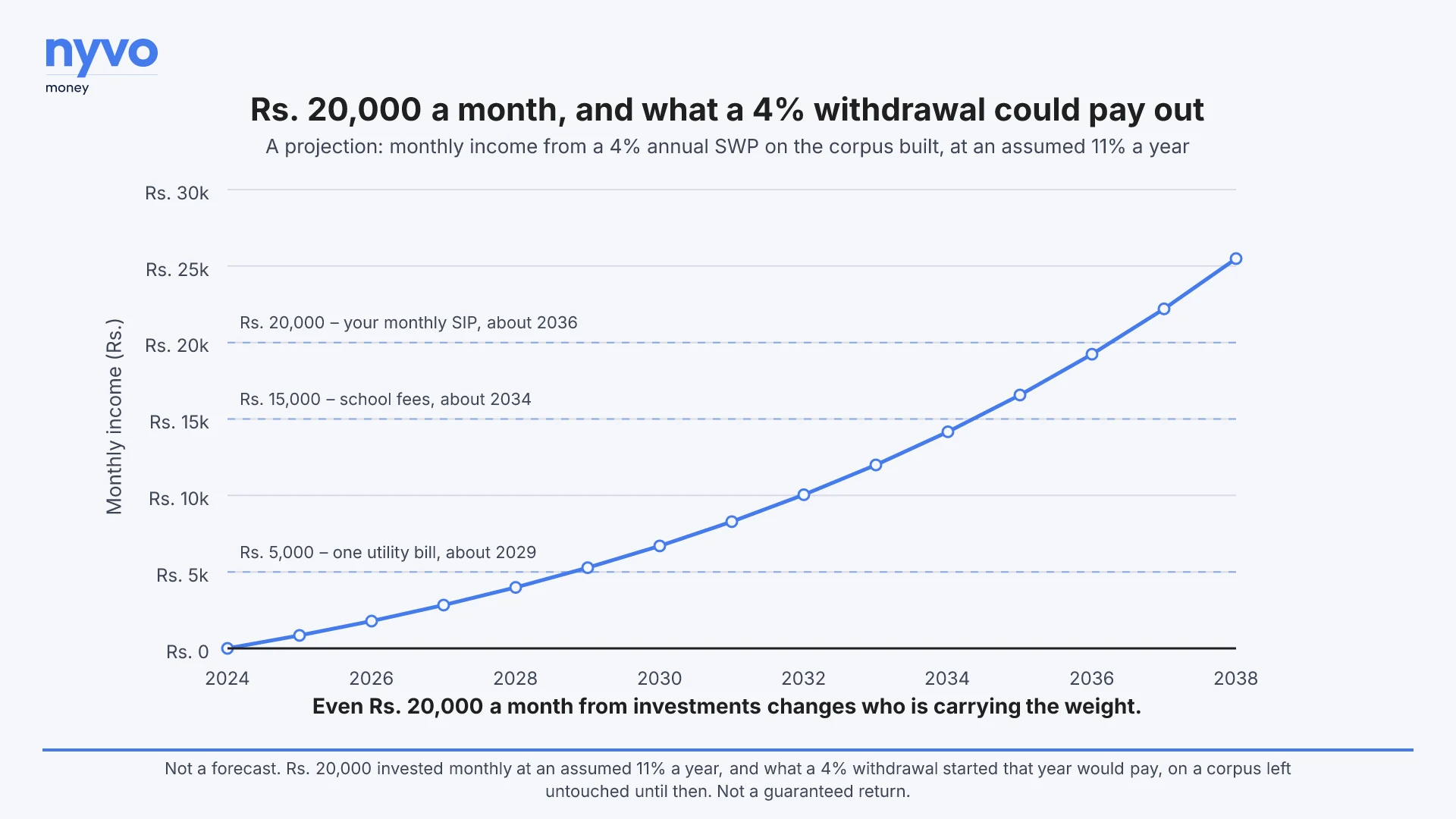
A projection at an assumed 11% a year, not a forecast or a guaranteed return. Each point is what a 4% withdrawal begun that year would pay, on a corpus left untouched until then.
Say your household needs Rs. 1 lakh a month to run comfortably. Right now your salary covers all of it.
Now say your investments generate Rs. 20,000 a month reliably.
You still have your job. But you are no longer depending on every single rupee from that salary to keep the household running. That Rs. 20,000 could become your holiday fund, your emergency buffer, money that lets one partner take a break after a child is born, or simply the confidence to say no to a role that is making you miserable.
So How Does Your Money Actually Pay You?
There are several real ways this happens. Not theories. Actual structures you can use.
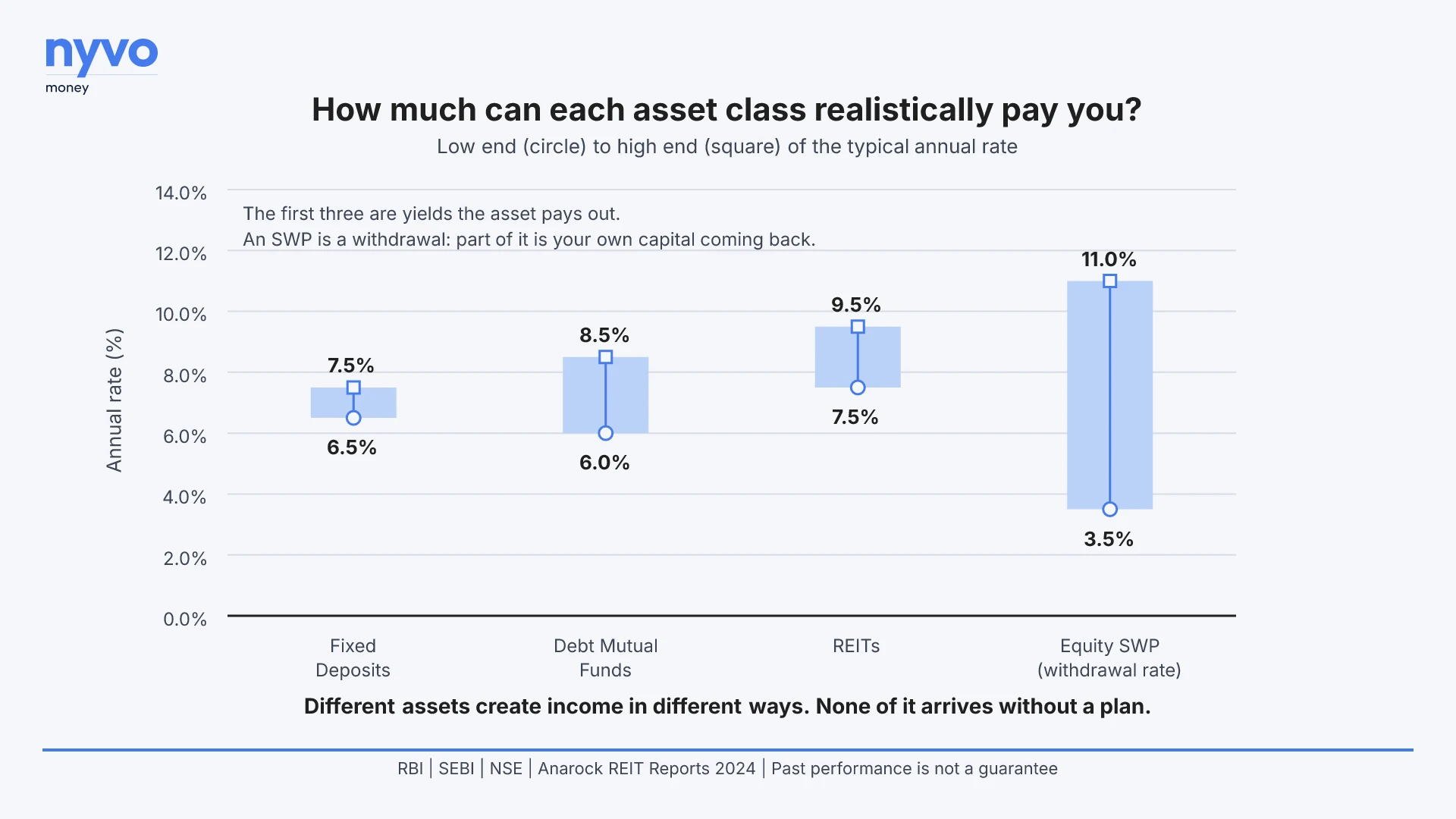
Interest comes from fixed deposits, bonds, and certain debt funds. Predictable. Unglamorous. Often exactly what a family plan needs.
Rent comes from property. But you do not always need to own an entire flat. REITs, Real Estate Investment Trusts, are SEBI-regulated structures that let you participate in income-generating real estate. Under SEBI rules, REITs must distribute at least 90% of their net distributable cash flows to unit holders.
A Systematic Withdrawal Plan, or SWP, lets mutual fund investors withdraw a fixed amount at regular intervals. In July 2026, SEBI extended standing instructions for SWPs to mutual fund units held in demat form, with the facility rolling out by April 2027. One important note: a withdrawal is not free money. You are redeeming part of your investment. The underlying corpus still needs to be sized and managed carefully.
Dividends from equity stocks and equity-oriented funds can also contribute, though they are harder to predict.
It requires money upfront, or time, or a specific skill, usually all three in some combination. Markets move in both directions. Returns are not guaranteed. Inflation and taxes are real. And remember: cash arriving in your bank account does not automatically mean your investment earned that amount. With an SWP, part of the payment can simply be your own capital coming back to you. The goal isn’t just to create a monthly payment. It’s to build assets today that can support that payment sustainably and give your family more choices later.
Financial Freedom Is a Spectrum, Not a Switch
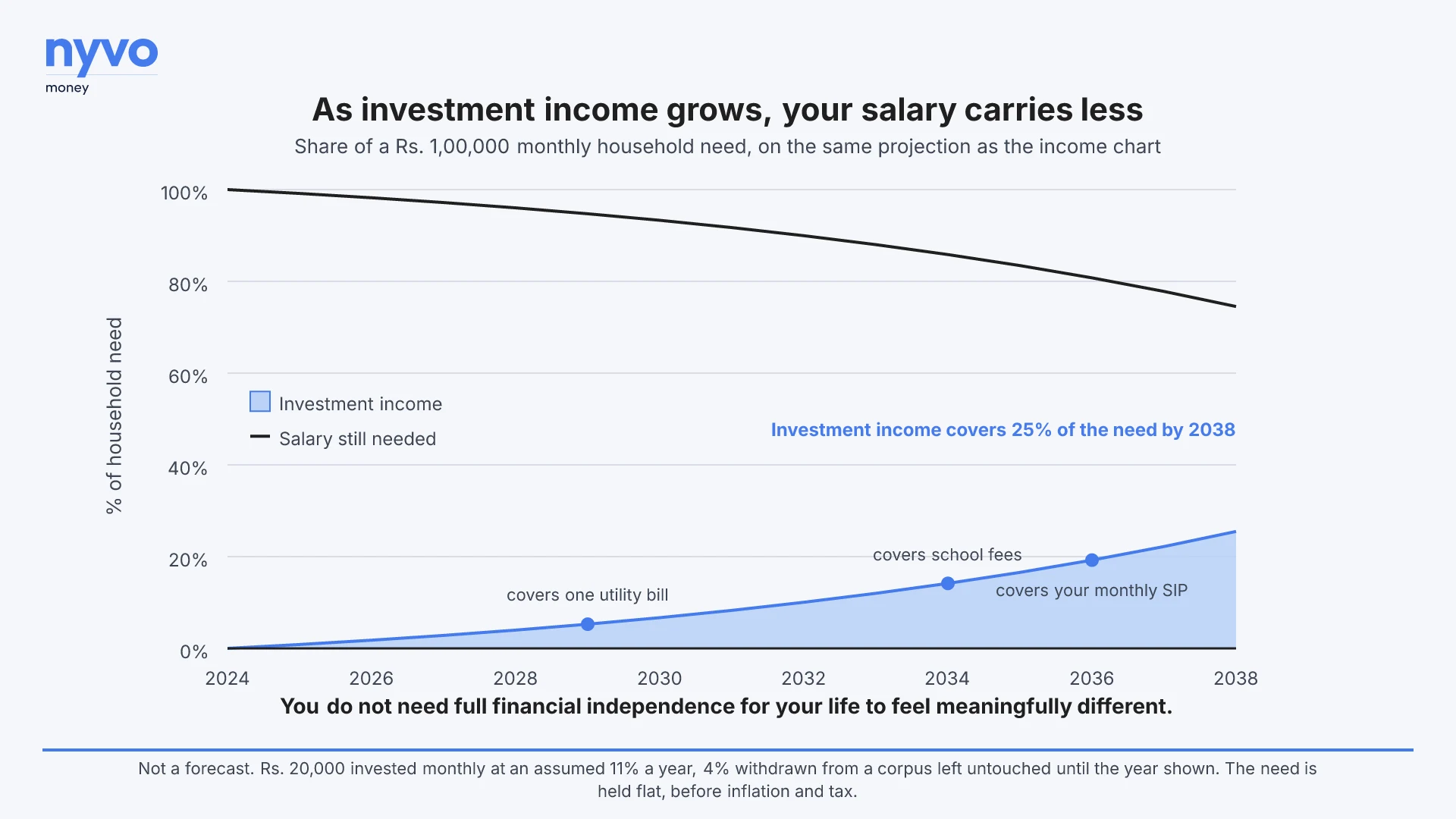
The same projection as the income chart above, with the Rs. 1,00,000 monthly need held flat, before inflation and tax.
The dream is usually presented as: make enough money so you never have to work again.
A more honest version for most families is: make enough money so you have a real choice about how you work.
You might love your career and stay in it for decades. You might want to start something of your own. Work four days instead of five. Take six months off at 35. Help ageing parents without your own finances falling apart. Leave a situation that is not good for you without wondering how next month’s rent gets paid.
Recent research on the FIRE movement suggests that financial independence does not necessarily mean abandoning work. For many people, the goal is closer to “work optional”: having enough financial security to decide what role work should play in their lives.
The point is not to stop working. The point is to make work something your family chooses.
Before You Build the Plan
There are a few things worth keeping in mind before turning the idea of monthly income into an actual portfolio.
- Returns are not guaranteed. Markets move in both directions, and the income an asset produces can change.
- Taxes depend on the investment. Interest, dividends, rent and capital gains can all be treated differently. For specified securities covered by Section 112A (Section 198 of the Income-tax Act, 2025), for example, long-term capital gains above the applicable ₹1.25 lakh annual threshold are currently taxed at 12.5%, subject to the relevant conditions.
- And a withdrawal isn’t necessarily a return. With an SWP, the money arriving in your account can include your own invested capital. The important question isn’t simply how much you can withdraw each month, but whether your portfolio can support that withdrawal sustainably after accounting for returns, inflation and taxes.
What Would You Actually Do With the Time?
Say your investments eventually cover one of your monthly expenses. Maybe that is enough to stop taking every weekend freelance project.
Suddenly Saturday is not another workday.
You could take your children somewhere. Visit your parents. Exercise. Cook a proper meal. Read a book. Do nothing at all and feel fine about it.
There is a kind of wealth that does not show well on any screen. Controlling your Tuesday afternoon. Taking a sick day without guilt. Making a big financial decision slowly because you are not desperate for the money right now.
Where to Start
Personal finance is usually treated like a spreadsheet. Income minus expenses. Returns. Tax. The numbers matter.
Don’t start by asking, “How much passive income should I make?” Start with one expense. Which monthly expense would you most like your assets to cover? It could be the electricity bill, groceries, school fees, an EMI, or eventually a much bigger part of your family’s expenses.
Once you have that number, turn it into an annual target:
Then work backwards.
- What kind of assets could potentially generate that cash flow?
- How much capital would you need?
- What level of risk are you comfortable taking?
- And how would inflation and taxes change the picture?
You don’t have to replace your salary to feel financially free. You just need to start reducing how much of your life depends on it.
Start with one expense. Build from there.
The SWP income and household charts are illustrations at an assumed 11% annual return, not a guaranteed outcome. Each point on them is what a 4% withdrawal begun in that year would pay, on a corpus left untouched until then; a household drawing the money along the way would arrive at a smaller one. The yield ranges are typical ranges, not a forecast. Tax treatment is as it stood on the date of this issue and can change with each Finance Act.
This piece explains how investment income works; it is not personal investment advice and names no security as a recommendation. Talk to a SEBI-registered adviser before building a portfolio for income.
Now in the nyvo app
Plan it for real in the nyvo app.
Goals, projections, fund grades and your whole family's money – in one place. Free. SEBI-registered.
Tools to try
Run the numbers yourself.
Free calculators that go with this issue. Built for Indian rules (rupees, inflation, tax regime).
- SWP Calculator – Mutual Fund Withdrawal Plan India
Plan a Systematic Withdrawal Plan for steady monthly income, and see how long your mutual-fund corpus lasts at a given withdrawal and expected return.
- FIRE Calculator India – Retire Early Corpus & Age
Financial Independence, Retire Early for Indian families: the corpus you need, the monthly SIP to reach it and your FIRE age. Set for 6-7% inflation.
Also worth reading

9 July 2026
The FIRE Number for India: How Much Do You Really Need to Retire Early in 2026?
The US 4% rule says 25× expenses. In India, inflation, medical costs, and no state safety net often push the real FIRE corpus closer to 30–33×.

9 July 2026
SM REITs In India: How ₹10 Lakh Now Buys You A Slice Of Commercial Real Estate
SEBI’s SM REIT framework lets investors buy listed slices of commercial real estate around ₹10 lakh. Understand yields, taxes, liquidity, and risks.