Forget the Rockets. Look at What Google Is Paying SpaceX For.
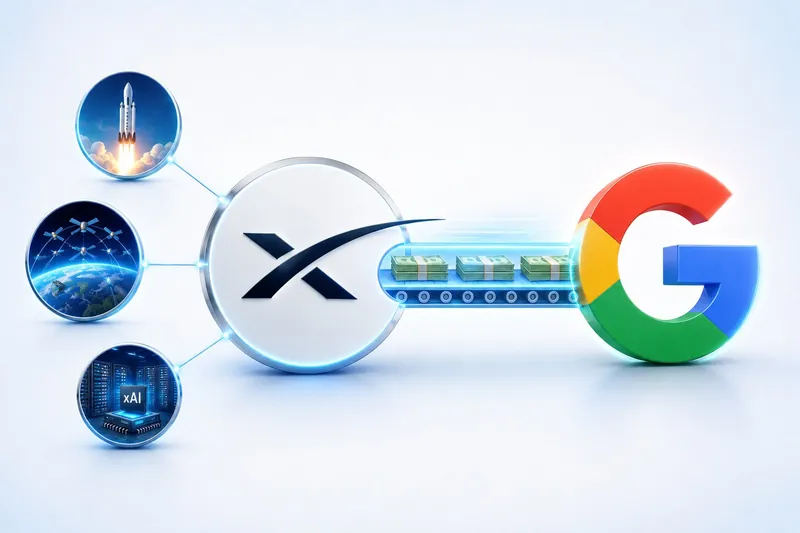
Everyone has heard of SpaceX. Most people think of rockets. A few think of Starlink. Almost nobody thinks of Google paying $920 million every single month to SpaceX.
The much spoken about IPO has more to the story.
A history lesson first
Before we get to SpaceX, let’s go back to 2010.
Tesla went public that year. Small company. Niche product. One car – a two-seat sports car priced above $100,000. But $290 million in accumulated losses. The Model S was still in the lab. Goldman Sachs initiated with a Neutral. Many called it overvalued.
And yet – Elon Musk was attached to it. And that changed something in how people saw the numbers.
Musk had PayPal. He had a vision. He spoke about first principles and civilisational missions. And slowly, the losses stopped looking like losses and started looking like investments in something bigger.
The people who bought Tesla in 2010 and held – through all the losses – made returns that look almost fictional today.
Source: CNBC
Now Musk is back. Bigger company. Bigger losses. Bigger story. And the halo is brighter than ever.
Same playbook. Different scale.
SpaceX is being sold as the new Tesla. The framing is irresistible: visionary founder, years of losses the market misunderstood, generational upside for those brave enough to see it early.
But look at the actual numbers and the parallel starts to emerge. Tesla at IPO was tiny and loss-making. SpaceX is enormous and loss-making.
| Tesla IPO – 2010 | SpaceX IPO – 2025 | |
|---|---|---|
| Valuation at IPO | ~$2B – ~10× revenue at listing | $1.75 trillion – ~94× annual revenue |
| Losses at IPO | $290M cumulative losses | $4.94B in 2025 + $4.28B in Q1 2026 alone |
| What losses are funding | The Model S – a mass-market product that eventually sold to millions of ordinary people | xAI – Musk’s AI company: $6.4B operating loss in 2025, $7.7B capex in Q1 2026 |
Sources: SEC filings, TechCrunch
Tesla’s losses were funding the Model S – a product that eventually sold to millions of ordinary people. SpaceX’s losses are substantially funding xAI, Musk’s AI company, which he merged into SpaceX earlier this year.
xAI lost $6.4 billion from operations in 2025 and consumed another $7.7 billion in capital expenditure in Q1 2026 alone. Retail investors buying the SpaceX IPO are partly funding a separate AI bet.
You think you know what SpaceX does
Most people buying this IPO think they’re buying rockets. Maybe Starlink. Maybe Musk’s vision of Mars.
But quietly, while the rocket coverage dominated headlines, SpaceX became something else entirely.
Google – one of the most powerful technology companies on earth, with its own data centres, its own chips, its own cloud infrastructure – is renting computers from SpaceX.
Source: RTE
Read that again.
Anthropic is paying SpaceX $1.25 billion a month for the same reason. That’s over $2 billion a month from just two customers – before Starlink revenue, before a single launch contract.
Over $2 billion a month – from two customers
Monthly payments to SpaceX for AI computing, before any Starlink or launch revenue
Sources: RTE, Yahoo Finance · contracts run through 2029
Sources: RTE, Yahoo Finance
Why would Google, with hundreds of billions in cloud infrastructure, go to a rocket company for computing power? Because Google Cloud’s own backlog nearly doubled to $460 billion in Q1 2026.
This isn’t a rocket story. It isn’t even a Starlink story. It’s a story about a company that now controls three chokepoints simultaneously – at a moment when demand for all three is unlike anything the world has seen before.
Satellite internet Starlink – the network everyone knows. |
Launch capacity A monopoly on launch capacity – the part that made the headlines. |
Computing infrastructure Over $2B a month from Google and Anthropic alone. |
That’s where the valuation premium is potentially coming in.
So what’s the catch?
Morningstar values SpaceX at $780 billion. The IPO wants $1.75 trillion.
What it’s worth vs what it’s asking
SpaceX valuation, US$ billions
Sources: Morningstar, CNBC
Sources: Morningstar, CNBC
Faith in the infrastructure moat. Faith in the AI bet. Faith in the founder. Two of those three are measurable.
The infrastructure moat Measurable. The Google and Anthropic contracts are real. The monopoly on launch capacity is real. |
The AI bet Measurable – and worrying. The xAI losses are accelerating, not narrowing. |
The founder Not measurable. This one runs on faith alone. |
SpaceX might be the next Tesla. The infrastructure story is genuinely compelling and genuinely underreported. But the question worth asking before you invest isn’t “do I believe in Elon Musk?”
Right now, for most people, it’s the story.
Now in the nyvo app
Plan it for real in the nyvo app.
Goals, projections, fund grades and your whole family's money – in one place. Free. SEBI-registered.
Tools to try
Run the numbers yourself.
Free calculators that go with this issue. Built for Indian rules (rupees, inflation, tax regime).
← Newer issue
Trading the Monsoon: For the First Time in India
Older issue →
Your NPS Just Got an Upgrade. Here’s How Your Retirement Income Changes.
Also worth reading
21 May 2026
Flipkart's IPO has been ‘Coming Soon’ since 2019
Flipkart's IPO has been deferred, again. Here's why Walmart hit pause, what the numbers actually say, and what it tells us about the state of India's IPO market in 2026.

5 June 2026
International Mutual Funds Are Outperforming. But How Accessible Are They?
The best-performing route for Indian investors last year ran straight out of the country – through Taiwanese chips, US tech and global gold. The Nippon India Taiwan fund returned 195.7%. The catch: SEBI's overseas-investment cap means the door is half-shut.