International Mutual Funds Are Outperforming. But How Accessible Are They?
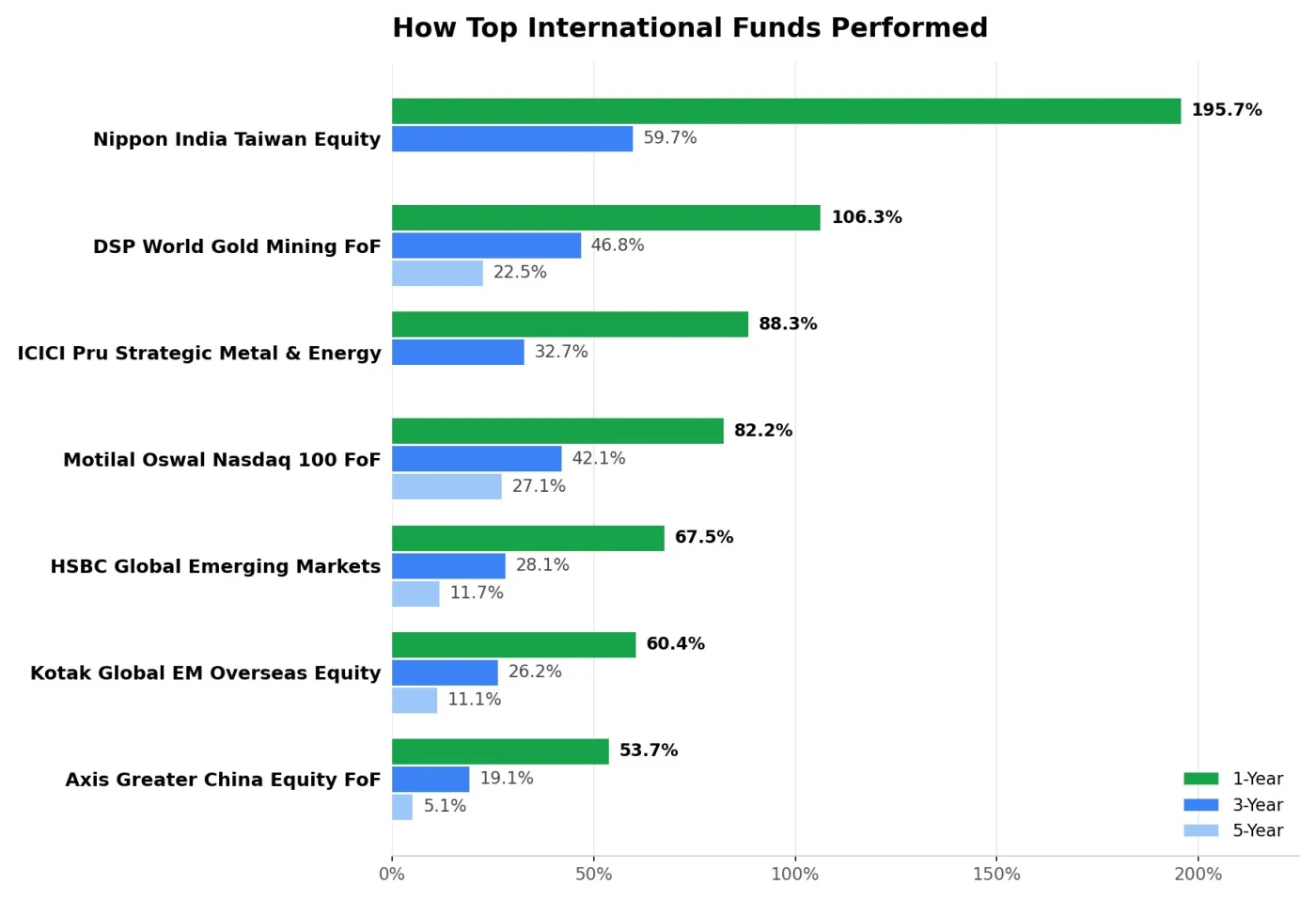
The best-performing route for Indian investors last year ran straight out of the country – through Taiwanese chips, US tech and global gold. The Nippon India Taiwan fund returned 195.7%. The catch: SEBI's overseas-investment cap means the door is half-shut.
By Harsh Soni

The best-performing route for Indian investors last year ran straight out of the country – through Taiwanese chips, US tech and global gold. The catch: the door is half-shut.
The Nippon India Taiwan Equity Fund’s 1-year return. ₹1 lakh quietly became ₹2.96 lakh – while your Nifty SIP was up a comparatively pedestrian 14%.
While most Indian investors were watching domestic markets underperform, a different story was unfolding. Mutual funds investing in foreign stocks – US tech giants, Taiwanese chipmakers, global gold miners – delivered the kind of returns most domestic investors only read about in hindsight. The catch? Getting your money into these funds right now is harder than it should be.
What's driving the returns? Three stories, all going right at once
And underneath all three runs one invisible tailwind: the rupee keeps weakening against the dollar. Even before a single foreign stock moves, an Indian investor in a dollar-denominated fund gets a boost purely from the exchange rate.
The numbers: how top international funds performed
The access problem
SEBI caps how much Indian mutual funds can collectively invest abroad. Once a fund hits that ceiling, it stops accepting fresh money – not redemptions, just new investors trying to get in. The industry-wide annual cap is around $7 billion, with a maximum of $1 billion per individual fund house.
The practical result shows up clearly in fund tables: most top-performing international funds are open for SIPs – small monthly investments – but have shut the door on lump-sum investments. With Edelweiss Greater China, Edelweiss US Technology or PGIM India Emerging Markets, you can invest ₹5,000 a month – but you cannot write a single cheque for ₹5 lakh. Only a handful, like Franklin Asian Equity Fund, remain fully open.
For an investor wanting to make a considered reallocation in one shot, this is a real structural barrier.
The risks are real too
The currency argument cuts both ways. When the rupee weakens, a fund earning in dollars is simply worth more rupees on the way back – a silent bonus most investors don't fully account for. But when the rupee strengthens, it works against you: a US fund that gained 3% in dollar terms, with the rupee also up 3% against the dollar, leaves your net return in rupee terms at roughly zero.
There is also a concentration problem hiding behind the diversification story. Taiwan, US tech and global mining have all surged for the same underlying reason – the AI boom and commodity repricing. When investors think they are diversifying across geographies, they may actually be concentrated in one big macro theme. International funds are a diversification tool, not the main act.
You may already own more global exposure than you think
One more thing worth knowing: some popular domestic funds already invest a portion abroad. If you own any of these, you already have more global exposure than you might realise – Edelweiss Technology Fund (26.6% overseas), DSP Healthcare Fund (18.1%), Franklin India Technology Fund (13.4%), and even Parag Parikh Flexi Cap Fund (10.6%), as of their March 2026 portfolios.
The bottom line
The returns from international mutual funds over the past year reflect real structural shifts in where the world's economic value is being created: AI hardware, US technology platforms, critical metals. Indian investors now have legitimate, regulated, rupee-denominated access to all of it.
But access is patchy, risk is real, and chasing last year's best performers is a reliable way to be disappointed.
Now in the nyvo app
Plan it for real in the nyvo app.
Goals, projections, fund grades and your whole family's money – in one place. Free. SEBI-registered.
Tools to try
Run the numbers yourself.
Free calculators that go with this issue. Built for Indian rules (rupees, inflation, tax regime).
- Mutual Fund Returns Calculator – SIP + Lumpsum India
Project combined returns from a mutual-fund SIP, lumpsum and top-ups in one place. Built for Indian equity, debt, hybrid and ELSS funds.
- SIP Calculator – Monthly Mutual Fund Returns India
Estimate the future value of a monthly mutual-fund SIP in India. Enter your amount, expected return and horizon to see the corpus and gain split.
- Lumpsum Calculator – One-Time Investment India
Estimate the future value of a one-time mutual-fund or fixed-income lumpsum in India. Enter principal, expected return and horizon to see the corpus.
← Newer issue
The Apps You Use Every Day Are Writing Their Own Rules
Older issue →
You can't lose with SIPs: if you stick around long enough
Also worth reading

21 May 2026
The mutual fund return number: choose your reality wisely
Three metrics – CAGR, XIRR, Rolling Returns – tell three completely different stories about the same investment. Here's which one you should actually be using.

29 May 2026
You can't lose with SIPs: if you stick around long enough
Across 29 years of Indian equity market history and 120 diversified funds, no 10-year SIP investor has ever ended in the red. Not low probability – zero. The maths is straightforward; the behaviour is the hard part.