How game theory can help beat a falling market

Weigh the piano, then triple it
John von Neumann, the mathematician who founded game theory, reportedly had a rule for certainty. Work out the weight of a grand piano with six men singing around it, then build a floor that can take three times that weight.
This year, Indian markets put the piano on the floor. The Nifty 50 is down 13.7% since 2 January, and 6.3% in September alone.
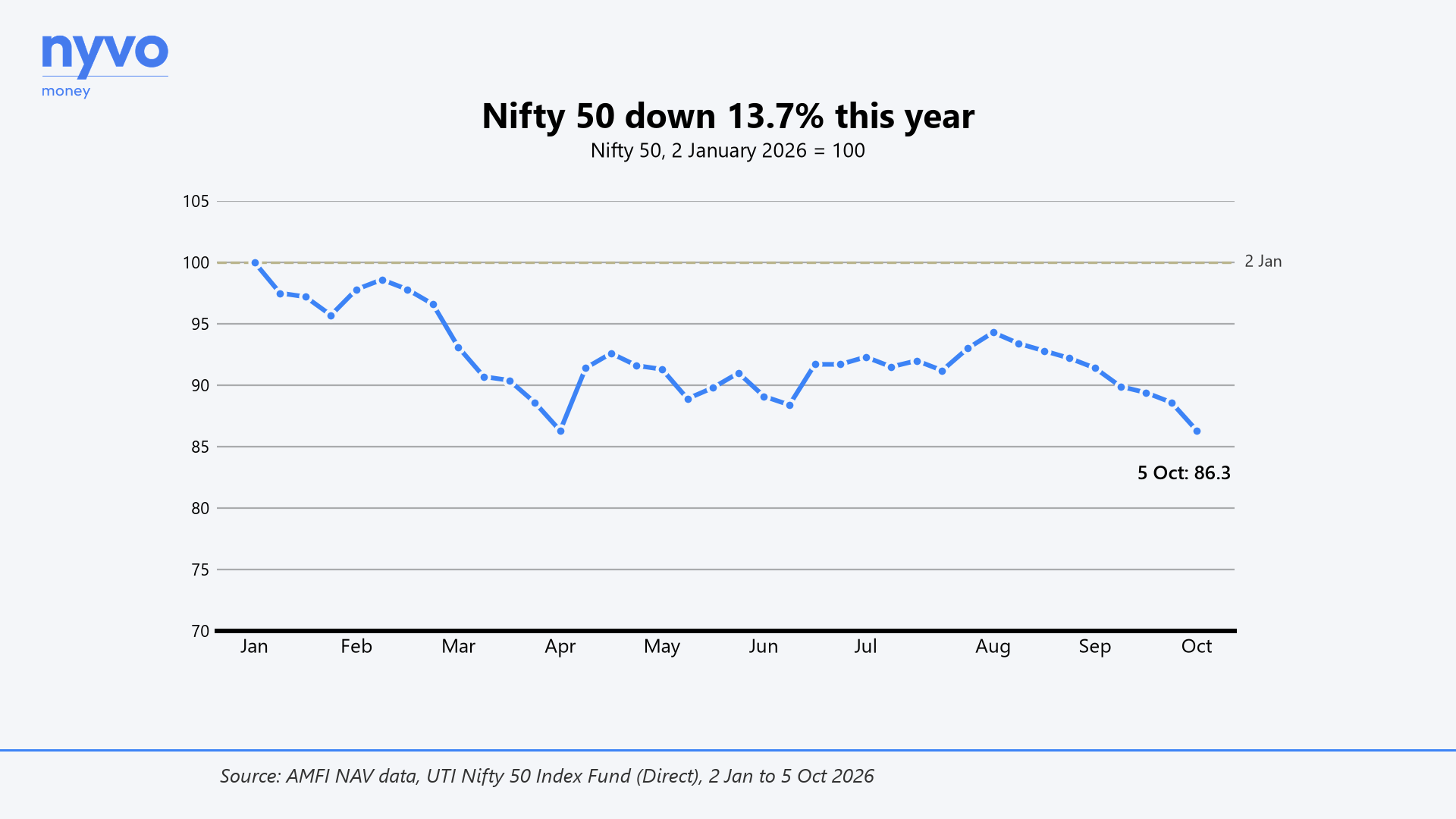
Whether your floor holds depends on whether you're playing the game right.
The market is the piano
Von Neumann's point went well beyond floors. In any game with other players, whether poker, a duel or an economy, working out the most likely outcome isn't enough.
You also work out the worst outcome that could reasonably happen, and build a strategy that survives it. A floor built for just a normal evening could collapse at the first party.
The market always recovered. That wasn't the problem.
Most of the time, Indian equity rewards patience. Since 2005, on all 549 days the Nifty had fallen 5% or more in a month, the next three years made money, averaging 15.7% a year.
In the same 21 years the Nifty also fell 15% or more nine times, including 2008, 2020 and now 2026. It recovered from all eight before this one. The catch was how long that took: 32.8 months after 2008's 59.5% fall.
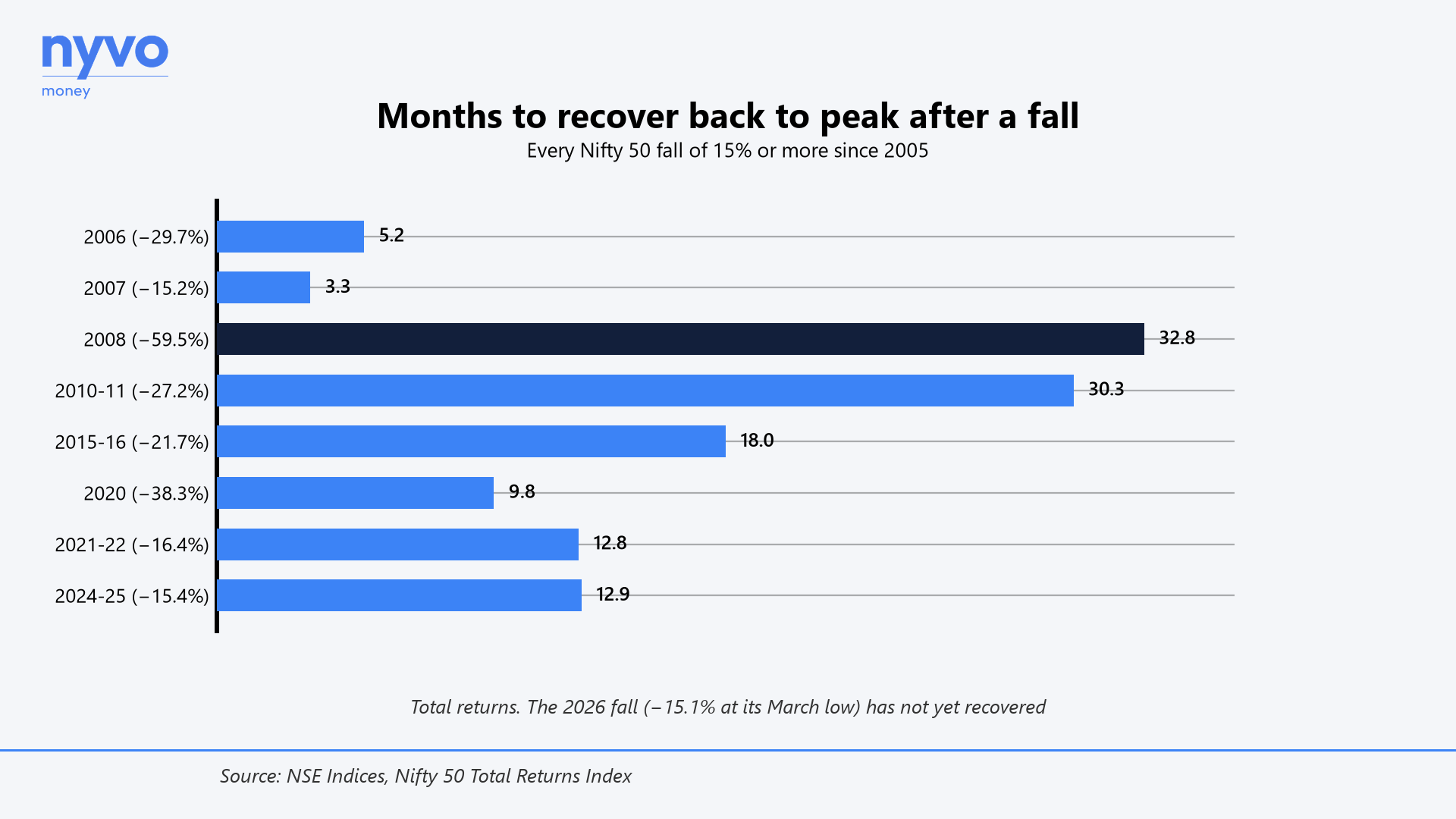
Anyone who needed their money inside those 32 months had to sell near the bottom. The market came back. Their money didn't.
The strategy to beat the game
In 1928, von Neumann proposed a strategy called the minimax strategy, for games where one player's gain is the other's loss. His rule: assume your opponent will make the best possible move against you. Then pick the strategy whose worst result is the least bad.
In short: minimise the maximum loss. You don't play for the biggest win. You play so that no move by the other side can ruin you.
In markets, the opponent is the market itself. Minimax means assuming it will make its worst reasonable move, a 2008, and holding a portfolio whose worst result you can live with.
Playing it right means building the floor
Von Neumann's framework isn't about finding the stock that goes up 200%. It's about a portfolio that doesn't collapse when the market dives. That's asset allocation: spreading money across equity, debt and gold, which don't fall at the same time.
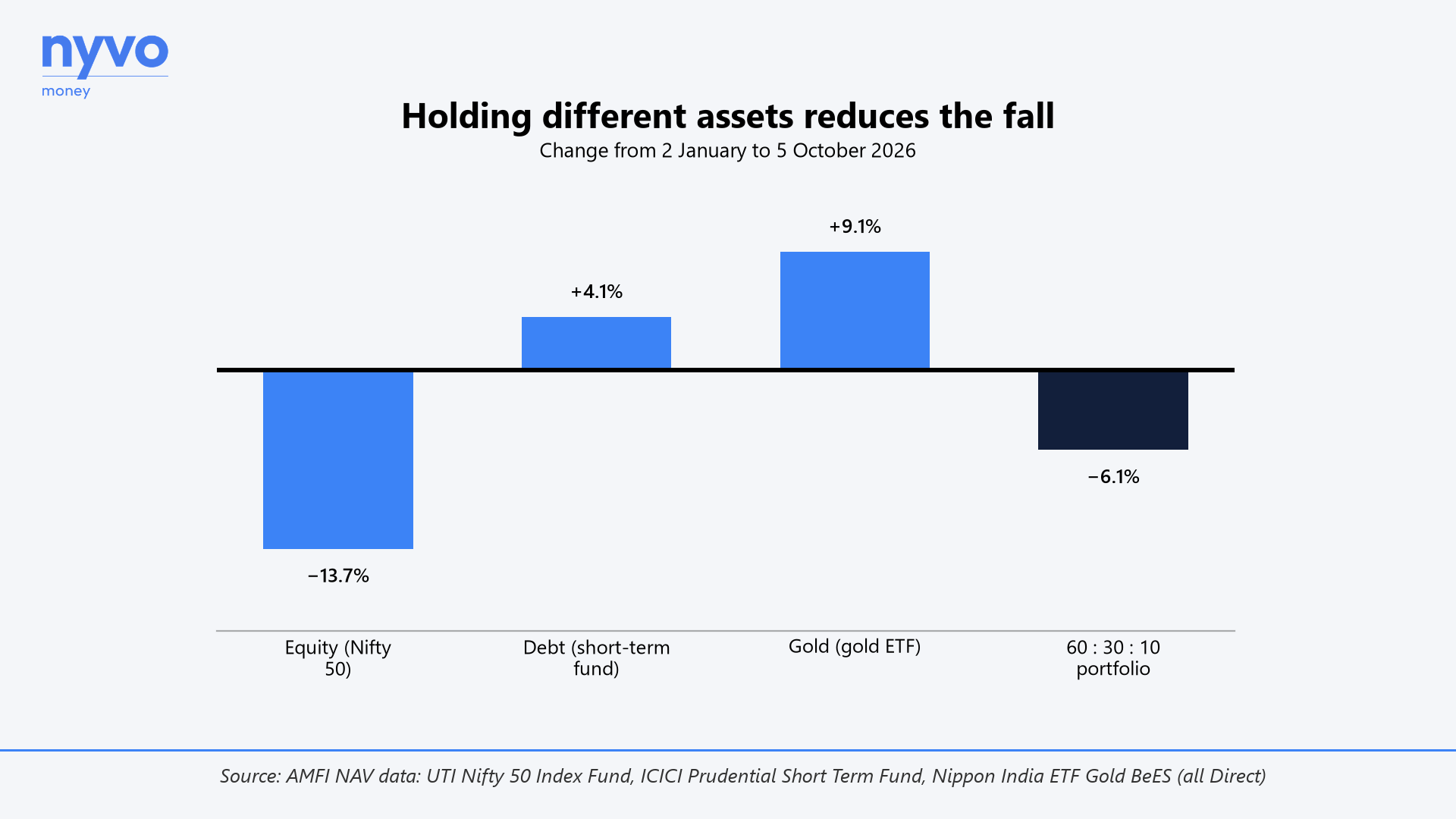
While equity fell, debt and gold rose. Holding all three cut the damage to less than half equity's fall, without guessing anything about the market.
Selling into a fall is the move minimax rules out
Every sale in a falling market has a buyer on the other side. The seller locks in the loss. The buyer gets the recovery.
To raise ₹1 lakh today, you have to sell about 16% more units than in January, and those units won't be there when the market comes back. That's the worst result made permanent, which is exactly what minimax tries to prevent.
So minimax acts before any fall happens. Money you'll need within the next three years moves early into less volatile assets like debt. Then even if the market falls, the money for your goals stays stable, and you never have to sell equity at a bad price.
Buying the dip works if you have time
On the other side of the table, the same 16% works for you: a ₹10,000 SIP now buys about 16% more units than in January.
But buying the dip only pays if you can wait for the recovery. Since 2005, no seven-year stretch in the Nifty has lost money, while one-year stretches lost money 18.2% of the time.
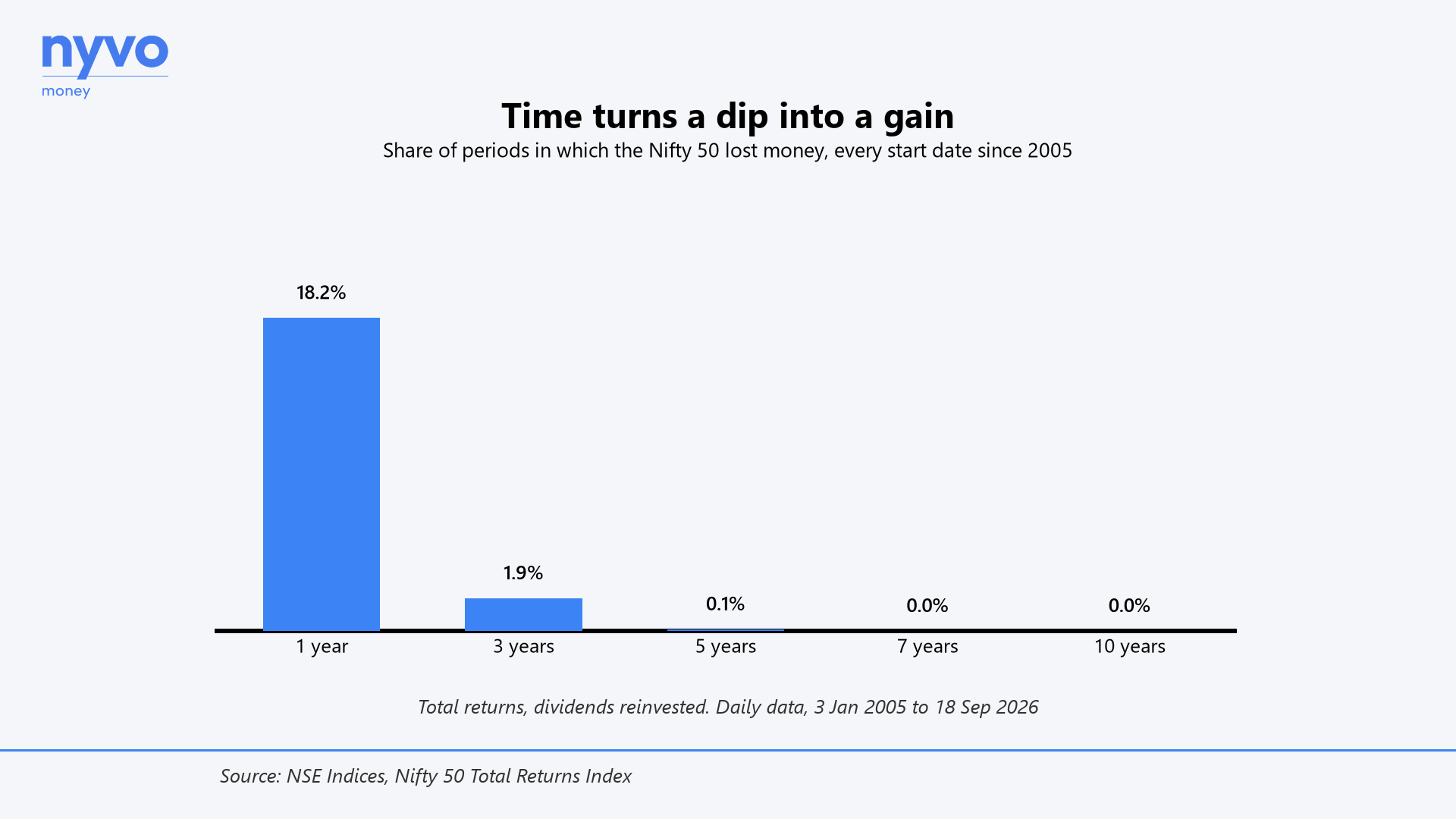
The returns also come in a few sharp days. All ten of the Nifty's best days came when it was at least 10% below its peak.
₹1 lakh put in the Nifty in 2005 grew to ₹14.4 lakh. Missing just those ten days, out of 5,385, would have left ₹6.8 lakh. With seven years or more ahead, buying the dip is the patient side of the trade.
Now test your own floor
This fall is a free stress test, and the results are already in your portfolio. Check them against the index while they're fresh.
The piano will come back, heavier some year. A floor built for three pianos doesn't need to know when.
The takeaway
- The Nifty recovered from all eight of its earlier 15%+ falls since 2005, but after 2008 that took 32.8 months. The risk is needing your money before the recovery.
- Selling into a fall makes the loss permanent. Minimax moves money needed within three years to debt before any fall, so goals stay stable.
- Buy the dip only with money that can wait seven years or more. All ten of the Nifty's best days since 2005 came during falls of 10% or more.
Now in the nyvo app
Plan it for real in the nyvo app.
Goals, projections, fund grades and your whole family's money – in one place. Free. SEBI-registered.
Tools to try
Run the numbers yourself.
Free calculators that go with this issue. Built for Indian rules (rupees, inflation, tax regime).
- SIP Calculator – Monthly Mutual Fund Returns India
Estimate the future value of a monthly mutual-fund SIP in India. Enter your amount, expected return and horizon to see the corpus and gain split.
- Lumpsum Calculator – One-Time Investment India
Estimate the future value of a one-time mutual-fund or fixed-income lumpsum in India. Enter principal, expected return and horizon to see the corpus.
Also worth reading

27 August 2026
Two Philosophies of Asset Allocation – and What Works Best in India
Ray Dalio built a portfolio for every phase of the economy. Chris Cole thinks the thing that saved Dalio's portfolio may not save the next one. Both approaches, in plain English, and what each would look like for an Indian investor.

29 May 2026
You can't lose with SIPs: if you stick around long enough
Across 29 years of Indian equity market history and 120 diversified funds, no 10-year SIP investor has ever ended in the red. Not low probability – zero. The maths is straightforward; the behaviour is the hard part.

24 September 2026
The Seven Deadly Sins of Investing, in Indian Fund Data
Seven ways Indian investors lose money that have nothing to do with the market, each one measured against real fund data.