Would a Vegetarian Portfolio Have Made You Richer or Poorer?
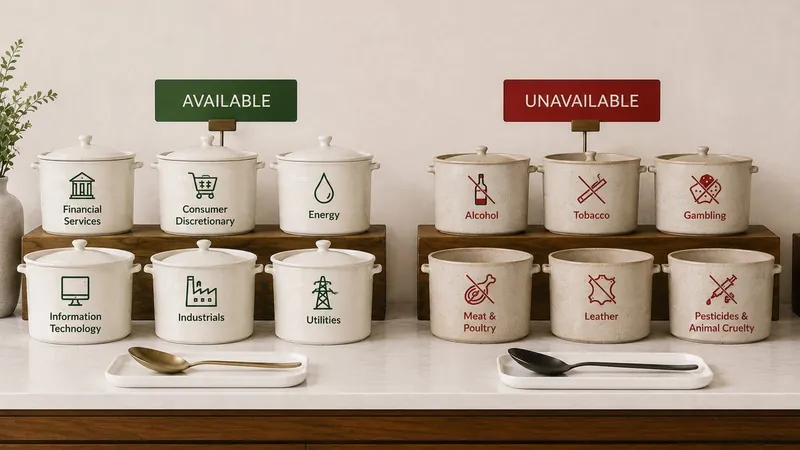
The BSE Saatvik 100 screens out alcohol, tobacco, gambling, narcotics, leather, meat and poultry, pesticides, and animal cruelty.
Translate that to the dinner table and you've basically got a vegetarian, teetotal, non-gambling portfolio. So did the conscience cost you anything?
The verdict: almost nothing
Saatvik 100 is carved straight out of the BSE 500. BSE's own backtest puts the two nearly on top of each other:
| Return window | Saatvik 100 | BSE 500 |
|---|---|---|
| 5-year CAGR | ~11.11% | ~11.12% |
| 10-year CAGR | ~13.70% | ~12.57% |
Pick either one blind and you wouldn't spot the difference. No real cost, no real halo.
Why the screen barely moves the needle
Because it never touches the part of the market that matters. Unlike Shariah indices, which cut interest-based banking entirely, Saatvik keeps HDFC Bank, ICICI, SBI, Axis and Kotak fully in place.
What actually leaves is a short, specific list:
So you drop a handful of names and keep the single biggest return-driver in the index fully intact. A values screen that leaves your largest holding alone was never going to cost much – or change much.
The catch: it's a large-cap bet
An 11–14% CAGR is just an ordinary large-cap return – which is all Saatvik really is. The gap could open up in a raging bull run, when the BSE 500's mid- and small-cap exposure tends to sprint past large caps. Today's dead heat says more about the current regime than about the ethics screen.
The trade nobody actually checks
Screened funds usually come with a quiet tax: give up a little return to stick to your principles. That's the deal most buyers assume they're signing.
Saatvik doesn't really charge it – it cuts products, not sectors, and those products are a thin slice anyway. The strange part: almost nobody verifies this. They read the label, feel the fit, and buy – bracing for a cost that isn't there.
The honest pitch
This isn't a groundbreaking product – it's a plain large-cap index with a short "no" list. But if you genuinely won't hold liquor, tobacco or gambling stocks, that's the useful takeaway: the identity-aligned choice isn't costing you anything worth worrying about, at least not in this market.
The real story isn't the ethics at all. It's what the near-zero gap quietly reveals – how much of India's large-cap return is concentrated in a handful of financial giants that no "ethical" screen dares to touch.
Now in the nyvo app
Plan it for real in the nyvo app.
Goals, projections, fund grades and your whole family's money – in one place. Free. SEBI-registered.
Tools to try
Run the numbers yourself.
Free calculators that go with this issue. Built for Indian rules (rupees, inflation, tax regime).
- SIP Calculator – Monthly Mutual Fund Returns India
Estimate the future value of a monthly mutual-fund SIP in India. Enter your amount, expected return and horizon to see the corpus and gain split.
- Lumpsum Calculator – One-Time Investment India
Estimate the future value of a one-time mutual-fund or fixed-income lumpsum in India. Enter principal, expected return and horizon to see the corpus.
← Newer issue
I Asked ChatGPT to Build My Portfolio. Here's Where It Lied to Me.
Older issue →
Having Lots of Credit Cards Is a Trap More Than a Power Move
Also worth reading

29 May 2026
You can't lose with SIPs: if you stick around long enough
Across 29 years of Indian equity market history and 120 diversified funds, no 10-year SIP investor has ever ended in the red. Not low probability – zero. The maths is straightforward; the behaviour is the hard part.

5 June 2026
International Mutual Funds Are Outperforming. But How Accessible Are They?
The best-performing route for Indian investors last year ran straight out of the country – through Taiwanese chips, US tech and global gold. The Nippon India Taiwan fund returned 195.7%. The catch: SEBI's overseas-investment cap means the door is half-shut.