Where Did All Our Money Go?

Rahul is a software engineer in Bengaluru earning ₹1.4 lakh a month and Priya works in marketing at ₹1.3 lakh, which puts them together at ₹2.7 lakh a month and squarely inside the top 5% of earners in a country where the median household income sits at around ₹25,000 a month. They pay their bills on time, they don't throw money at random things, and they actively talk about saving.
And yet on the 22nd of every single month, Rahul opens his banking app and the number is wrong.
No big purchase. No vacation. Not one thing either of them can point to. Just a balance that doesn't match what two careful people bringing home ₹2.7 lakh should have at month-end, and the worst part is he can't explain it, because the answer isn't one thing.
It's four, and all four of them run automatically without needing anyone to make a single bad call.
Before we get to the fourth one, the one that genuinely frustrates people when they finally see it clearly for the first time, let’s start with the one that almost every household underestimates by almost exactly the same amount every month.
LEAK 1The Spending You Don't Add Up
Here is a quick exercise: add up everything your household spent on food last month, and count everything: Swiggy, Zomato, grocery runs, the restaurant on Friday, the chai from outside the building, the coffee before work, the corner shop for milk and bread, the weekend vegetable market, all of it as one combined number.
Got it? Now add 40% to that number.
That second number is almost certainly your actual spend, because food is the single most consistently underestimated spending category in every household budget study done across Indian cities.
The reason isn't that people are dishonest but that food spending is the one category where money leaves your account in 30, 40, sometimes 50 separate transactions per month, meaning it never feels like one number and you never see it as one number, so the total surprises you every time you add it up.
Rahul estimates ₹19,000 a month on food. His actual spend across all transactions last month was ₹27,000, and the ₹8,000 gap isn't hiding in one dramatic purchase.
It's in ₹340 for Tuesday Swiggy because nobody wanted to cook, ₹2,800 for the Thursday grocery run, ₹120 from the corner shop Saturday morning, ₹1,200 at the restaurant Friday because everyone was too tired to think about cooking, ₹30 for chai outside the building, and ₹90 for the coffee Rahul picks up every morning because, as he told us, "the office coffee tastes like it gave up."
None of those felt like money leaving when they happened, and that's the entire mechanism, because money you don't consciously track doesn't feel like money you're spending, and by month-end the total is just quietly sitting there in your transaction history waiting to surprise you.
The biggest gap isn't in the categories Rahul watches. It's in the four small ones he never thought of as food spending at all, and that's exactly why the total keeps being a surprise every single month.
But if the food gap is the leak you can sort of see coming once someone points at it, the next one has been running for years and you've completely forgotten it exists.
LEAK 2The Charges You Stopped Noticing
Try this right now without looking at your bank statement: list every subscription your household pays for. Streaming, music, cloud storage, apps, gym memberships, kids' learning tools, anything that charges you on a monthly or annual basis.
Most people land on 4 or 5. The actual average for an urban Indian household, based on aggregated recurring payment data from platforms like Razorpay and BillDesk, is between 10 and 14 active charges per month, which means most people are unknowingly carrying 6 to 9 subscriptions they've completely stopped noticing.
Rahul and Priya's full list: Netflix at ₹649 (premium plan, because the cheaper one has ads and the kids complained), Amazon Prime at ₹299 (originally for free delivery, now mostly watched on weekends), JioHotstar at ₹299 (cricket, which is non-negotiable in this house), Spotify at ₹119, a Google One storage plan from 2021 at ₹130 that auto-renewed after the free trial without any visible notification, a children's learning app at ₹299 that bills annually in April but converts to monthly in their records, the gym Rahul joined last January at ₹1,800 which he has visited 6 times total since March, and 2 to 3 smaller services that neither of them could name when we asked, adding up to around ₹900.
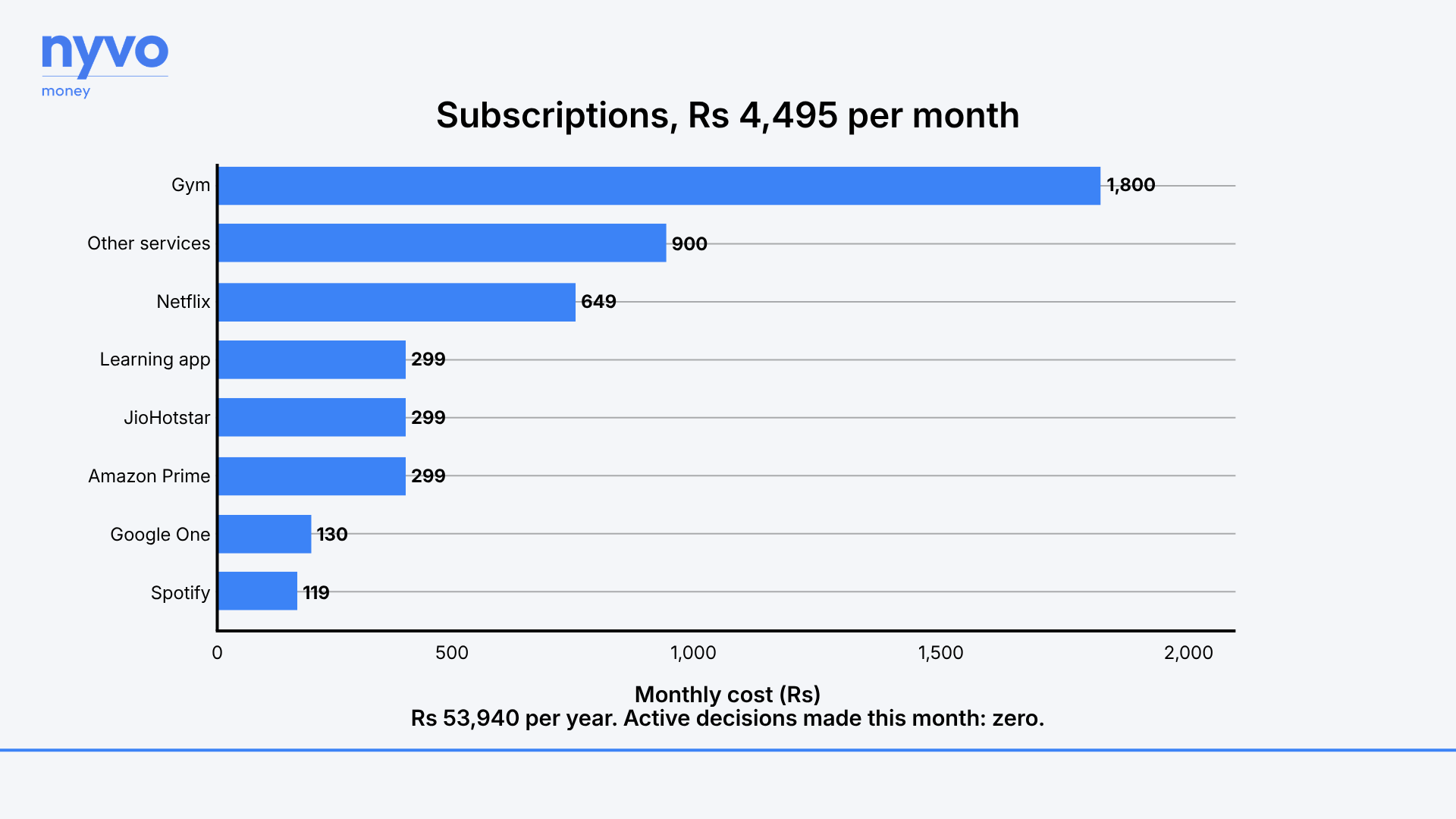
The reason this layer grew so silently is that subscription pricing is psychologically engineered to feel small: a monthly charge of ₹299 is 4 to 5 times easier for the brain to accept than a one-time charge of ₹3,600, even though they are exactly the same amount of money across a year, and every app and platform figured this out around 2018 and restructured their pricing models accordingly, so every household in India started collecting these charges one by one without any single moment where anyone looked at the full combined total and consciously said yes to all of it at once.
The fix is a 20-minute review of one bank statement. Most families never do it because they've never seen the total in one place at one time, and seeing the total in one place is the thing that actually changes the decision.
The third leak is the strangest of all four, because it's not a traditional spending problem. It's a timing problem, and the money it costs you isn't going anywhere wrong. It's just going at the most expensive possible moment instead of a cheaper one that was available a few hours earlier.
LEAK 3The Cost of Deciding Late
Think about the last time you ordered food delivery at 9:30pm because nobody had decided what to eat until 9:30pm. You paid a ₹40 platform surcharge on top of the delivery charge, which you could have avoided entirely with a decision made at 6pm, when cooking was still on the table, or ordering early at standard pricing was still an option, or figuring out something cheaper was still possible.
Think about the last time you paid for express shipping on a gift because you remembered the occasion the day before it happened. That ₹180 premium didn't buy you anything extra, it just compensated for the decision arriving 4 days late.
Think about the last time you booked a cab because you were already running behind, where an auto 10 minutes earlier would have done the same trip for ₹170 less.
Think about the ₹550 you've spent at an airport food court on a two-hour flight when the same food near your house cost ₹80.
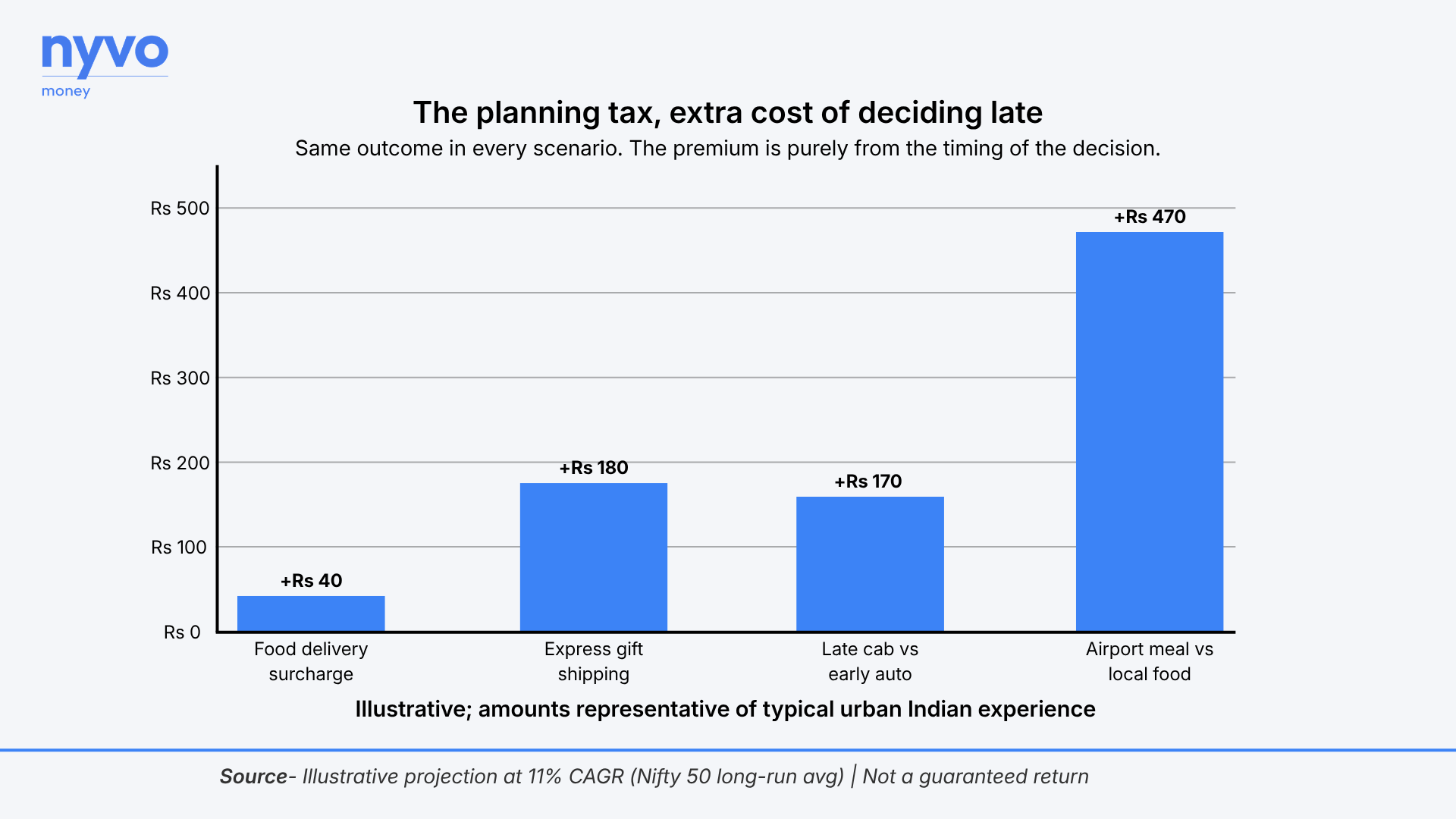
Individually, each of those is completely defensible. Together, this planning tax costs the average busy urban household somewhere between ₹3,940 and ₹8,000 every single month, and what makes it different from everything else in this piece is that the same dinner still gets eaten, the same gift still gets given, the same cab ride still happens.
Nothing is wasted. The money is just going at the moment when it costs the most rather than the moment, a few hours or a few days earlier, when it would have cost significantly less.
This entire category shrinks dramatically the moment a family starts making small decisions slightly earlier, not with a strict budget, not with a spending sacrifice, just by moving the decision point before the urgent moment hits, when you still have options.
So what if you fixed all three of these? Tracked the food gap, cancelled the forgotten subscriptions, started planning slightly ahead. Would that ₹40,000 raise from last year finally show up in savings? Almost certainly not, because of the fourth leak, which grows bigger every time your income does.
LEAK 4The Lifestyle That Grew With Your Salary
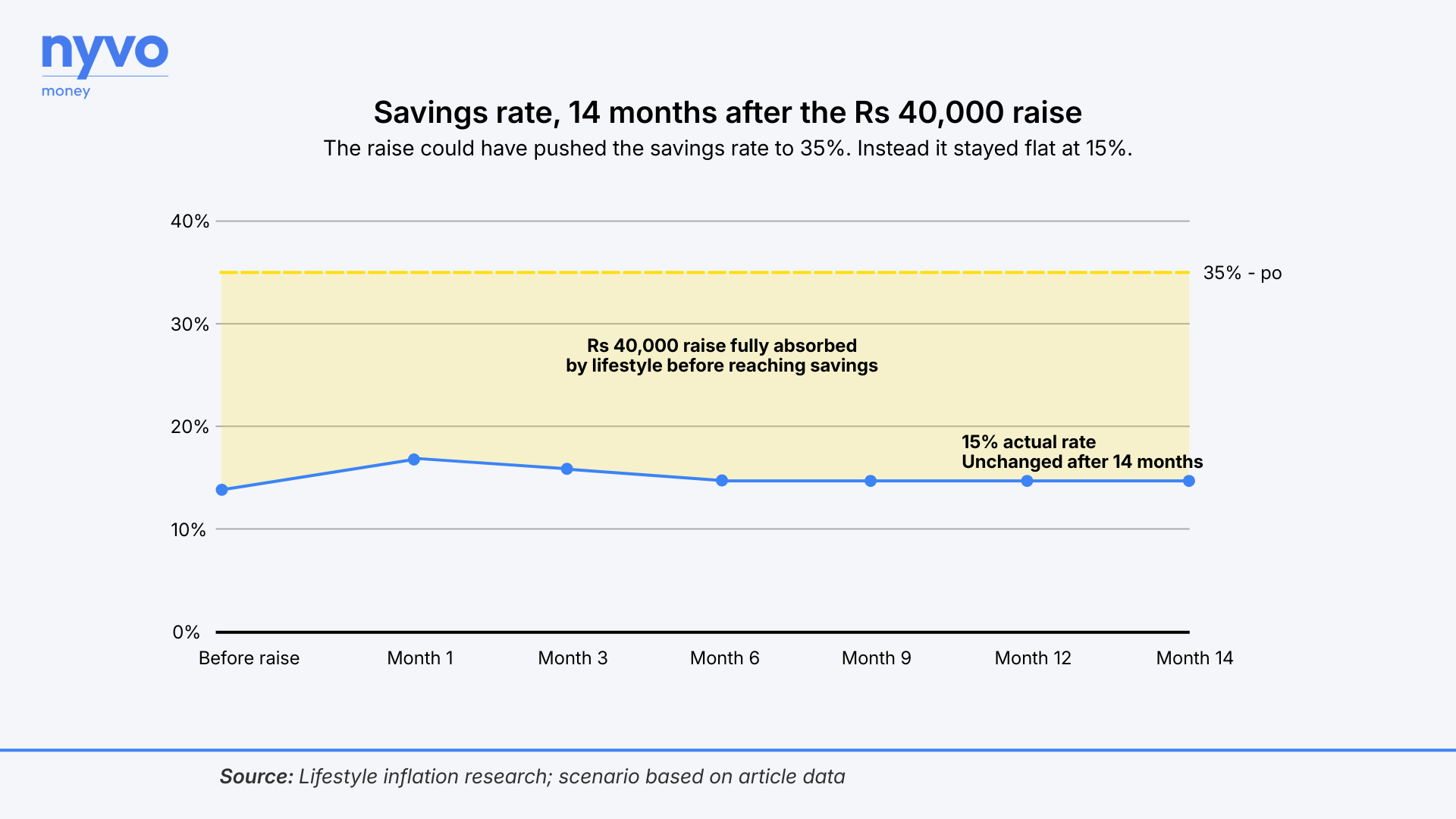
Last year Rahul got promoted and his salary went up by ₹40,000 a month. He was genuinely certain that would solve the 22nd-of-the-month problem. Fourteen months later, his savings rate as a percentage of income is almost exactly what it was before the raise happened, and the 22nd still feels the same.
This pattern is so consistent across income groups that economists who study household finances have a specific name for it: lifestyle inflation, which describes the near-universal tendency of household spending to expand at approximately the same rate as income, so that a raise gets absorbed into a new, higher baseline of what counts as normal spending before it ever reaches savings, because once income goes up the reference point for what feels proportionate also goes up at the same speed.
What did Rahul and Priya actually do with the extra ₹40,000? They switched from IndiGo to Air India for work trips because the upgrade is only ₹2,000 per ticket and felt genuinely earned after seven years of middle seats in economy.
They started ordering food delivery three nights a week instead of two because everyone is busier now and ₹400 per order doesn't feel like a significant decision when you're exhausted and it's 9pm.
Their daughter moved from a school costing ₹1.6 lakh a year to one costing ₹2.8 lakh a year, because it genuinely is a better school with better teachers and Rahul genuinely can afford it now.
Not one of those is an obvious mistake. Every single one makes sense on its own terms. And together they ensured that every rupee of the ₹40,000 raise was fully absorbed by the expanded lifestyle within 14 months, before any of it reached a savings account, and the feeling of being financially tight returned exactly on schedule.
This is why a family earning ₹30 lakh a year can feel exactly as stretched as a family earning ₹15 lakh. It's likely why your parents, who earned substantially less in absolute terms, may have actually saved a higher percentage of their income than you do: they didn't have 12 subscriptions quietly renewing, food delivery wasn't available at midnight in under 20 minutes, a salary increase didn't come with 15 new ways to immediately spend it, and lifestyle expanded slower because the infrastructure to expand it instantly didn't exist yet.
Income is what comes in. Wealth is what stays. Those two things are related but they are not the same thing, and the gap between them is exactly what these four leaks quietly eat through every month.
So What Actually Works
The natural response when you see all of this laid out is to build a budget and start cutting, and that works for about 21 days before it stops working, because cutting is mentally framed as loss and the brain treats sustained loss as punishment, and punishment only functions as a long-term behavior change strategy when your motivation to punish yourself holds up, which in practice is never very long.
What actually works is one different question. Not "what should I cut?" but instead: which of these expenses did I actively choose, and which ones just happened to me?
When families go through their spending with that one question, they find the same pattern almost every time: 2 or 3 categories where they'd genuinely spend more if they had the room because those things add something real to the life, and then 4 or 5 categories where the money went entirely by default, where nobody chose it, nobody values it, it just kept going because the path of least resistance runs directly through a bank account and nothing interrupted it.
The food gap runs because nobody adds it up as one number. The subscriptions run because cancelling requires effort and not cancelling requires none. The planning tax runs because busy people make decisions when they have to, not when it would cost them less. The lifestyle creep runs because more income feels like permission to live differently, and it is, just not ₹40,000 worth of differently when you're trying to build actual wealth at the same time.
None of this happened because Rahul and Priya are careless. It happened because money moves by default, and the default was designed by companies whose entire business model depends on your money moving toward them before you notice it moving.
The families who build wealth are not the ones earning more. They're the ones who interrupted the default. The difference between a family that builds wealth and a family that wonders where it all went is usually just that: one of them decided where the money was going before it left.
Now in the nyvo app
Plan it for real in the nyvo app.
Goals, projections, fund grades and your whole family's money – in one place. Free. SEBI-registered.
Tools to try
Run the numbers yourself.
Free calculators that go with this issue. Built for Indian rules (rupees, inflation, tax regime).
- Step-up SIP Calculator – Annual Increase Returns
Project a SIP that grows with your income. A 10% annual step-up can roughly double the 20-year corpus versus a flat SIP. Built for Indian equity returns.
- SIP Calculator – Monthly Mutual Fund Returns India
Estimate the future value of a monthly mutual-fund SIP in India. Enter your amount, expected return and horizon to see the corpus and gain split.
Also worth reading

5 June 2026
The Apps You Use Every Day Are Writing Their Own Rules
On June 1st, five giants – Amazon, Eternal, Meesho, Swiggy and Zepto – formed the Digital Commerce Coalition. One name is missing: Flipkart. Here's what seven years of regulatory pressure, eight platform-fee hikes and a room full of conflicts of interest add up to.

26 June 2026
Having Lots of Credit Cards Is a Trap More Than a Power Move
More credit cards feels like more power, but it's usually more trap – how stacking cards quietly raises spending, fees, and debt risk, and what actually helps your finances.

9 July 2026
Your First Salary Just Landed: The 20s Money Playbook for India (2026)
A first-salary money order for India: emergency fund, 50-30-20, health and term cover, SIPs, tax regime choice, credit-card traps, and what to avoid.