Is AI a bubble? Why the investors who say yes keep buying

What fund managers say about AI stocks
In October 2025, a record 54% of fund managers surveyed by Bank of America said AI stocks were in a bubble. A year later, the same survey found them holding more tech stocks than at any time since 2020.
On 20 October, Citadel founder Ken Griffin said AI is "almost certainly" in a bubble.
Calling it a bubble and buying anyway sounds contradictory. It's actually a strategy, and it has a 25-year paper trail.
What the people building AI say
In August 2025, OpenAI's Sam Altman said investors were "overexcited" about AI. Three months later, he put OpenAI's computing commitments at about $1.4 trillion over eight years.
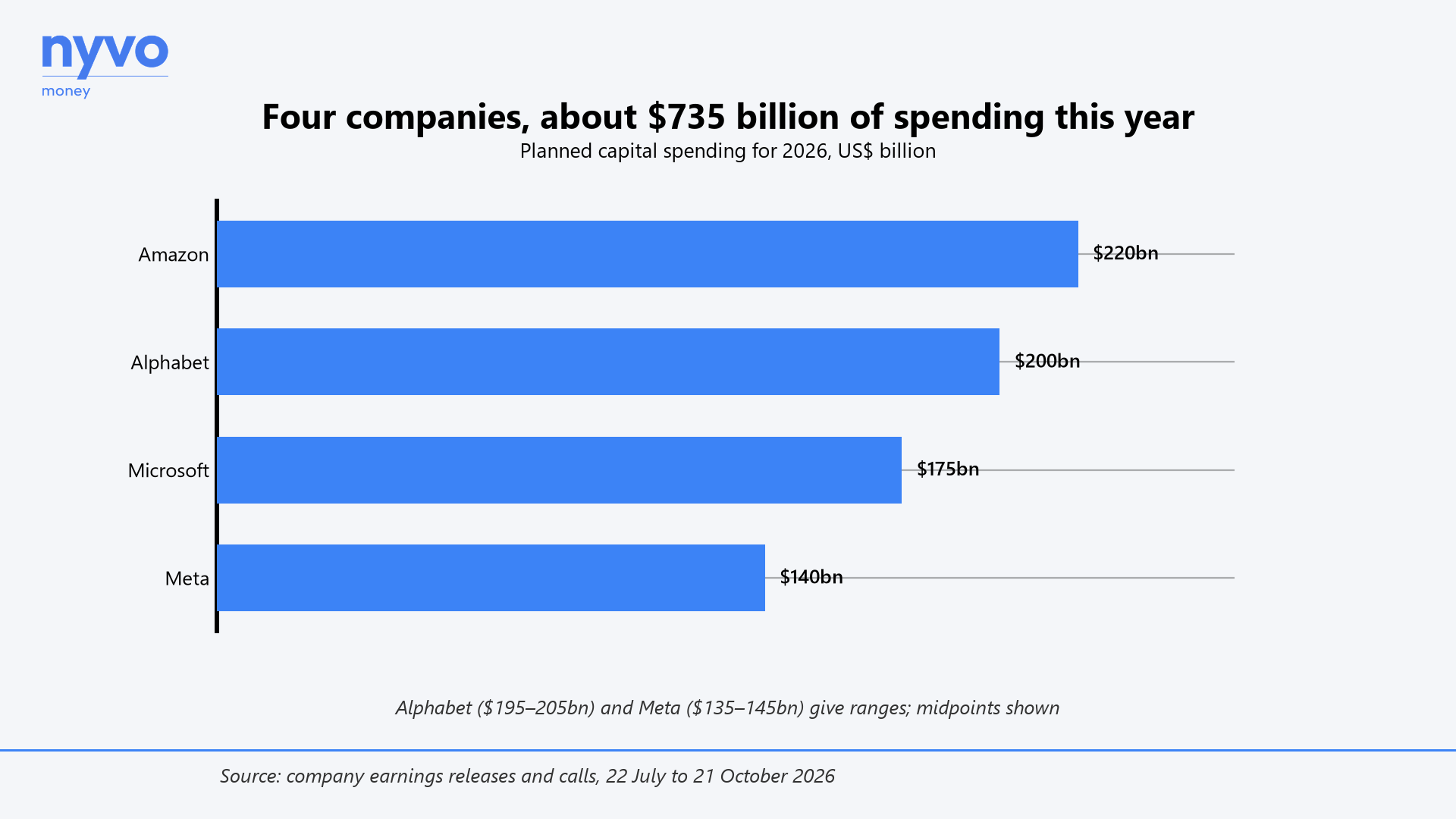
Mark Zuckerberg called a bubble "quite possible", but said wasting "a couple of hundred billion dollars" was a smaller risk than falling behind. On 21 October, Meta said it would spend $135–145 billion this year.
Why that doesn't mean a crash is close
If the people closest to AI think it's a bubble, the natural reading is that they're about to sell, and a fall is near.
The last tech bubble says otherwise. Knowing didn't make the smart money leave. It made them stay, and plan to leave first.
What hedge funds did in the dot-com bubble
In 2004, economists Markus Brunnermeier and Stefan Nagel studied what 53 hedge fund managers held from 1998 to 2000.
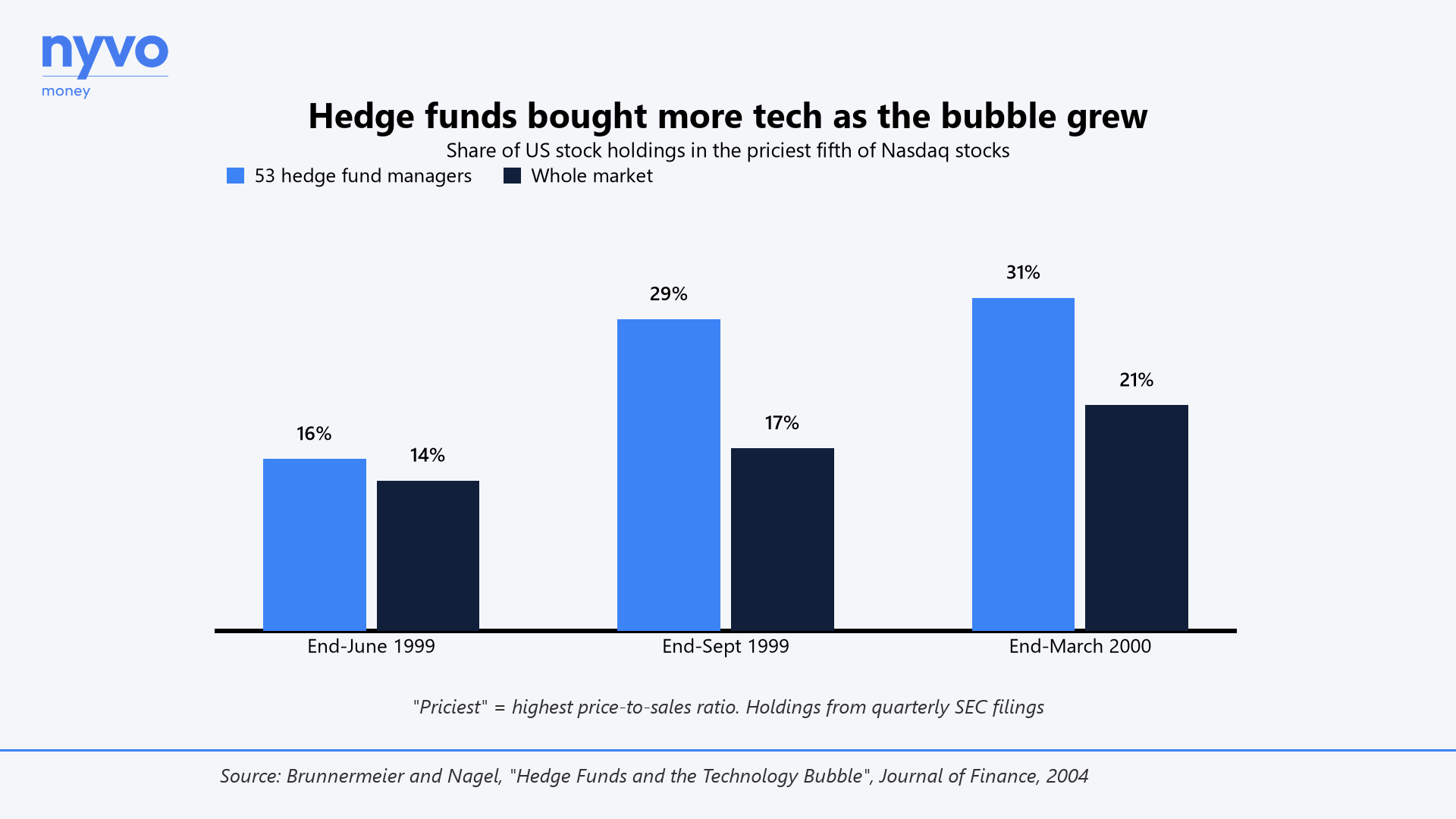
At the Nasdaq's peak in March 2000, these funds had 31% of their stock money in the priciest fifth of Nasdaq shares, against 21% for the market. They were "riding the bubble, not fighting it", the authors wrote.
They also got out stock by stock, cutting each holding before its price collapsed. A portfolio copying their tech picks beat similar stocks by 4.5% over the following quarter.
The fund that refused to ride it
Julian Robertson's Tiger Management had grown to $21 billion by 1998. It thought tech was overpriced, and in 1999 sold almost all of it.
So its investors left instead. In the last three months of 1999, Tiger lost about a quarter of its assets to withdrawals. On 30 March 2000, with about $6 billion left, Robertson shut it down, blaming a market run on "mouse clicks and momentum".
The Nasdaq had peaked 20 days earlier. Tiger was right. It just ran out of investors first.
Why nobody wants to sell first
A year before that study, Brunnermeier and Dilip Abreu had explained why. Traders spot a bubble at different times, and none knows whether they're early or late. One seller can't pop it. It takes many selling together.
So each one stays in and plans to leave just before the rest. That's how a bubble can outlast the moment most people agree it is one.
In July 2007, 14 months before Lehman Brothers collapsed, Citigroup's Chuck Prince put it plainly: "as long as the music is playing, you've got to get up and dance."
Cisco, the Nvidia of the dot-com bubble
The usual case against an AI bubble is that AI is real: the chips sell and the revenue is there. The internet was real too.
In 2000, Cisco sold the routers and switches the internet was built on, the way Nvidia sells the chips AI runs on today. In March 2000, Cisco was briefly the world's most valuable company. Today, at about $5.4 trillion, Nvidia is.
Cisco's shares closed at $80.06 on 27 March 2000 and fell 89% by October 2002. The business kept growing, from $18.9 billion of revenue in 2000 to $63.3 billion in 2026. The shares didn't get back to $80.06 until 10 December 2025, 25 years later.
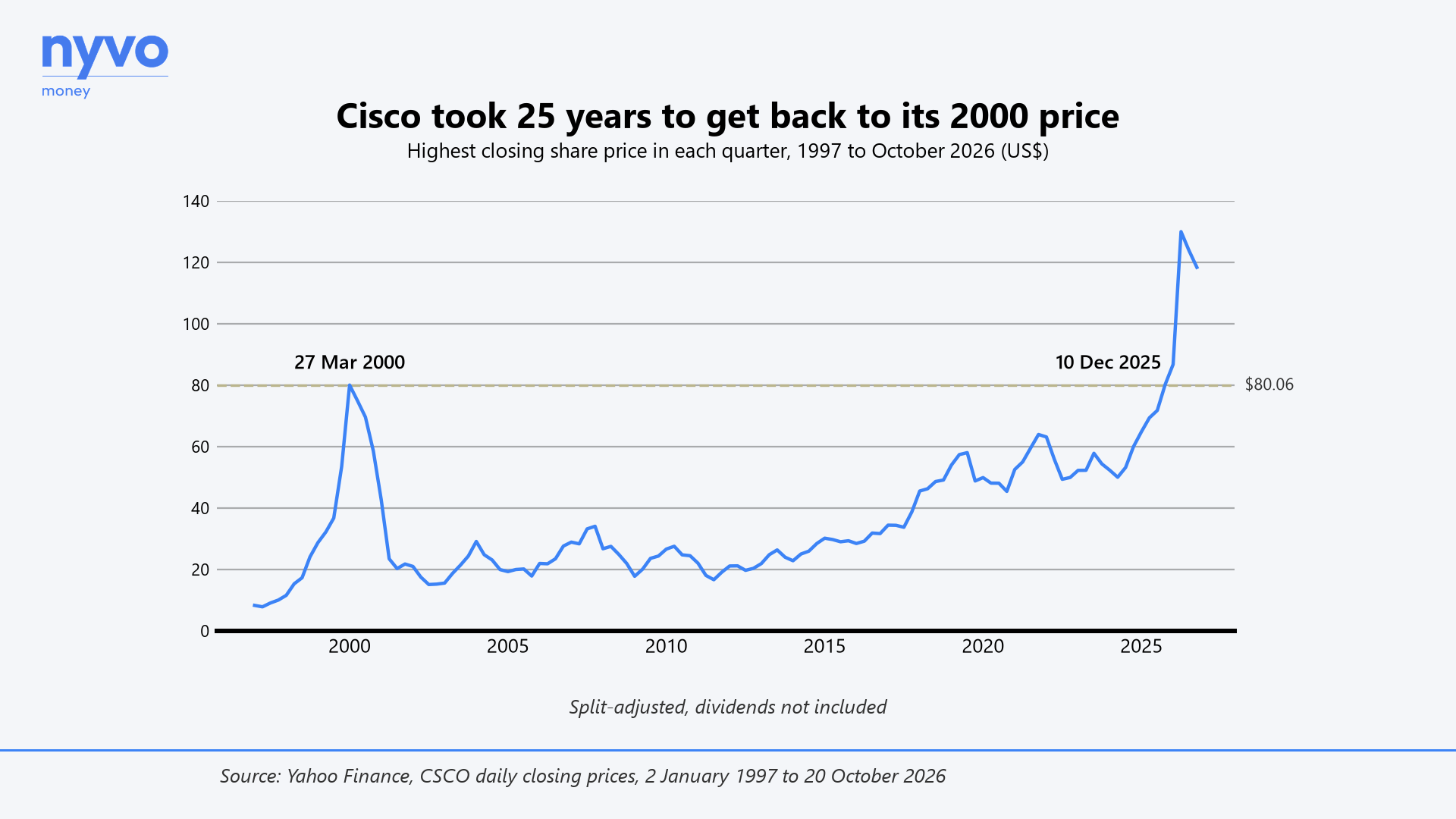
The internet was real. Being right about it didn't help anyone who bought Cisco at the top.
Where Indian investors come in
The Nifty 50 is down 12.7% this year. The Nasdaq-100 is up 18.1%, and more in rupees. For a household watching its Nifty SIP fall, that gap is hard to ignore.
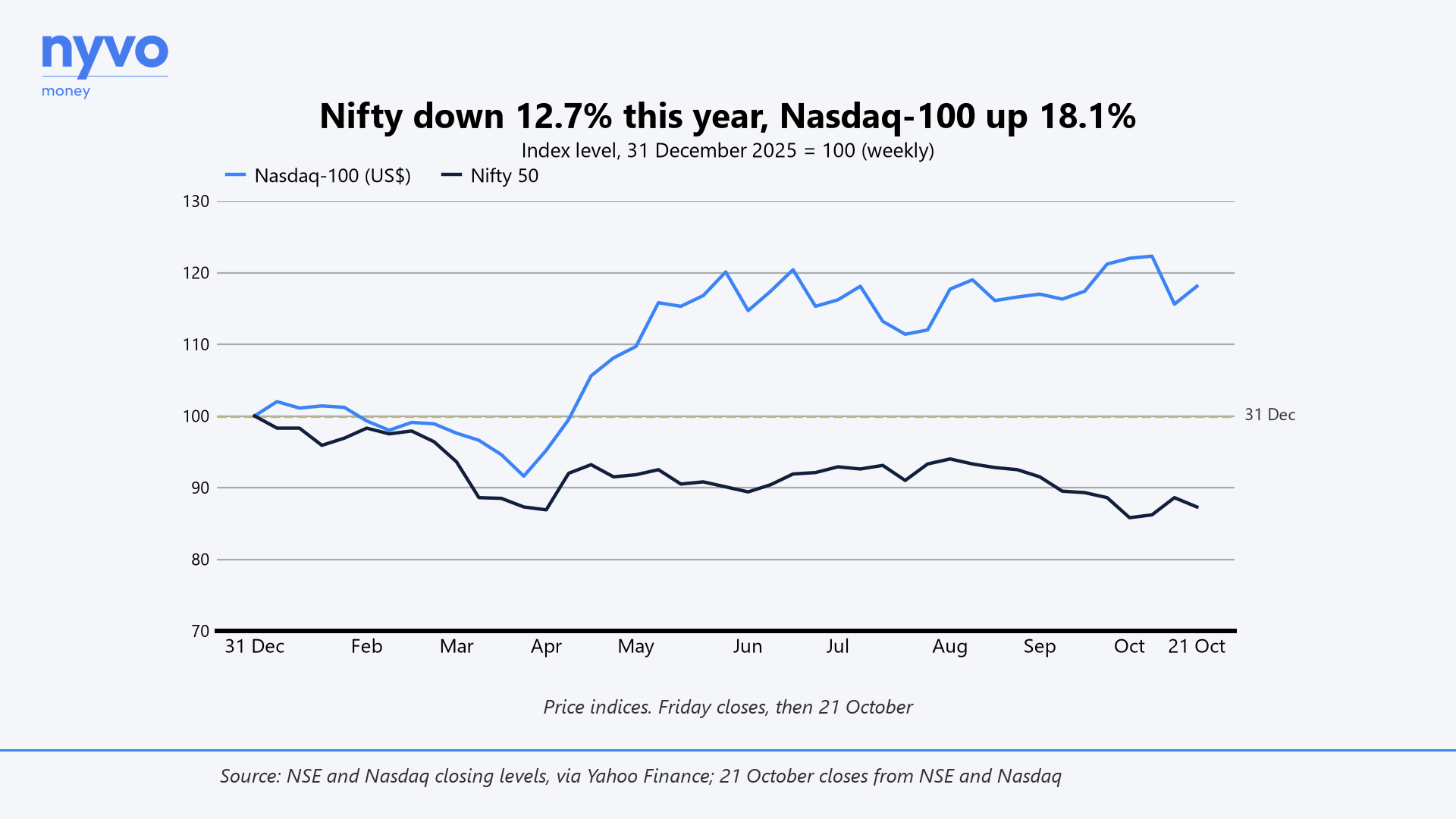
Indian money has followed it, the way it chases last year's winners. Funds investing overseas took in a net ₹4,523 crore from January to September, 3.1 times as much as a year earlier.
But none of India's Nasdaq-100 funds is taking lump sums or new SIPs. SEBI caps how much Indian funds can invest abroad, and that limit has been used up.
What this means for your money
Griffin and the fund managers can say "bubble" and stay in, because they plan to sell before everyone else. In 2000, the hedge funds that rode it avoided much of the fall. Someone has to buy what they sell: in February 2000, a month before the peak, US equity funds took in a record $53.7 billion.
A household can't time its exit like a hedge fund. It doesn't need to.
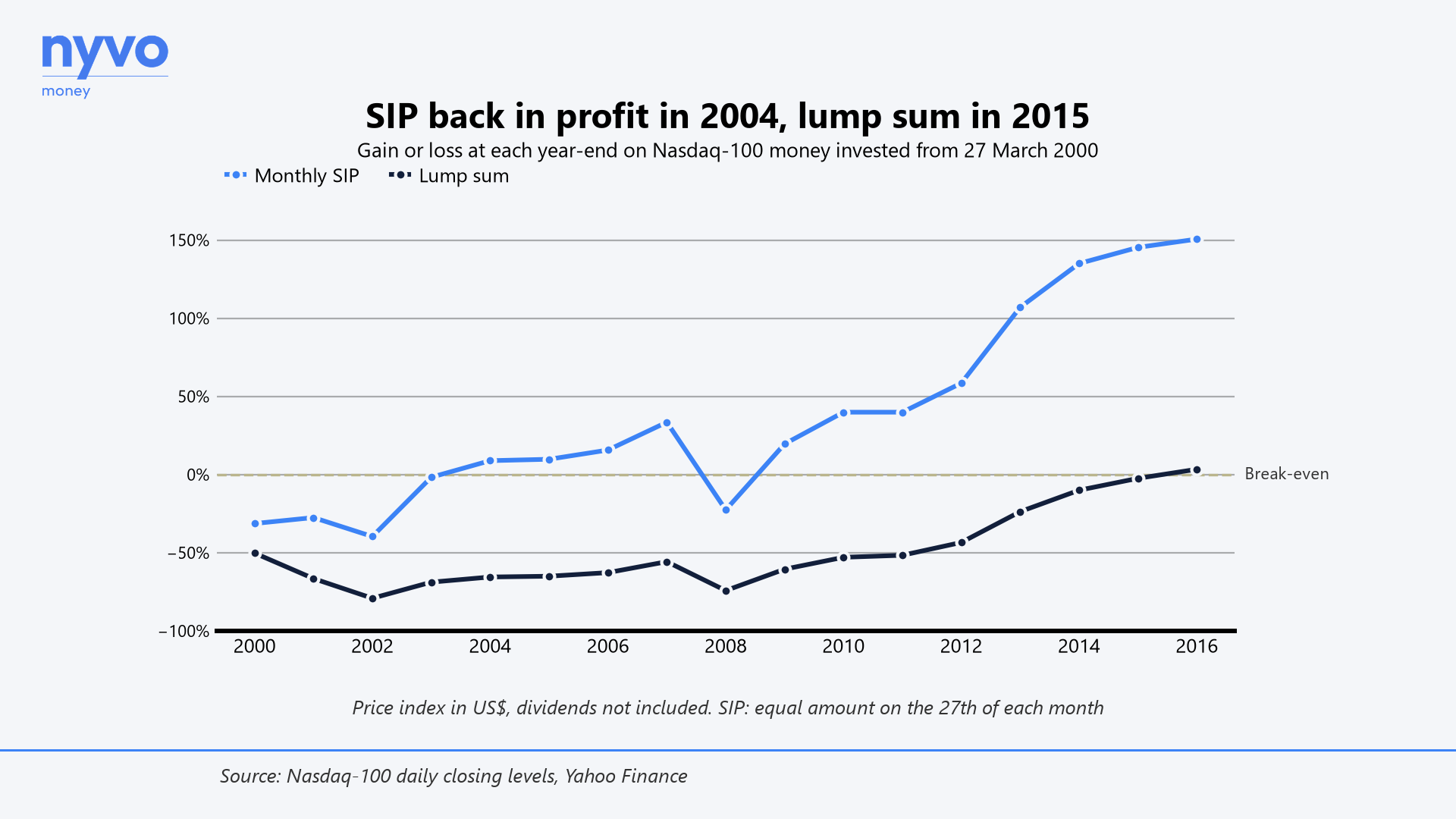
Take two people who put money into the Nasdaq-100 on 27 March 2000, the day it peaked. One invested a lump sum and got back to even in November 2015, 15 years later. The other started a monthly SIP and was back in profit by January 2004, in under four years. The SIP still fell as much as 54% on the way, and slipped into a loss again in 2008.
Neither of them knew 27 March was the top. The SIP didn't need to. It kept buying as prices fell, and in September 2002 the same monthly amount bought 5.5 times as many units as it had at the peak. By January 2004 its average cost was about a third of the peak price. So it was in profit even with the index still 68% below its high.
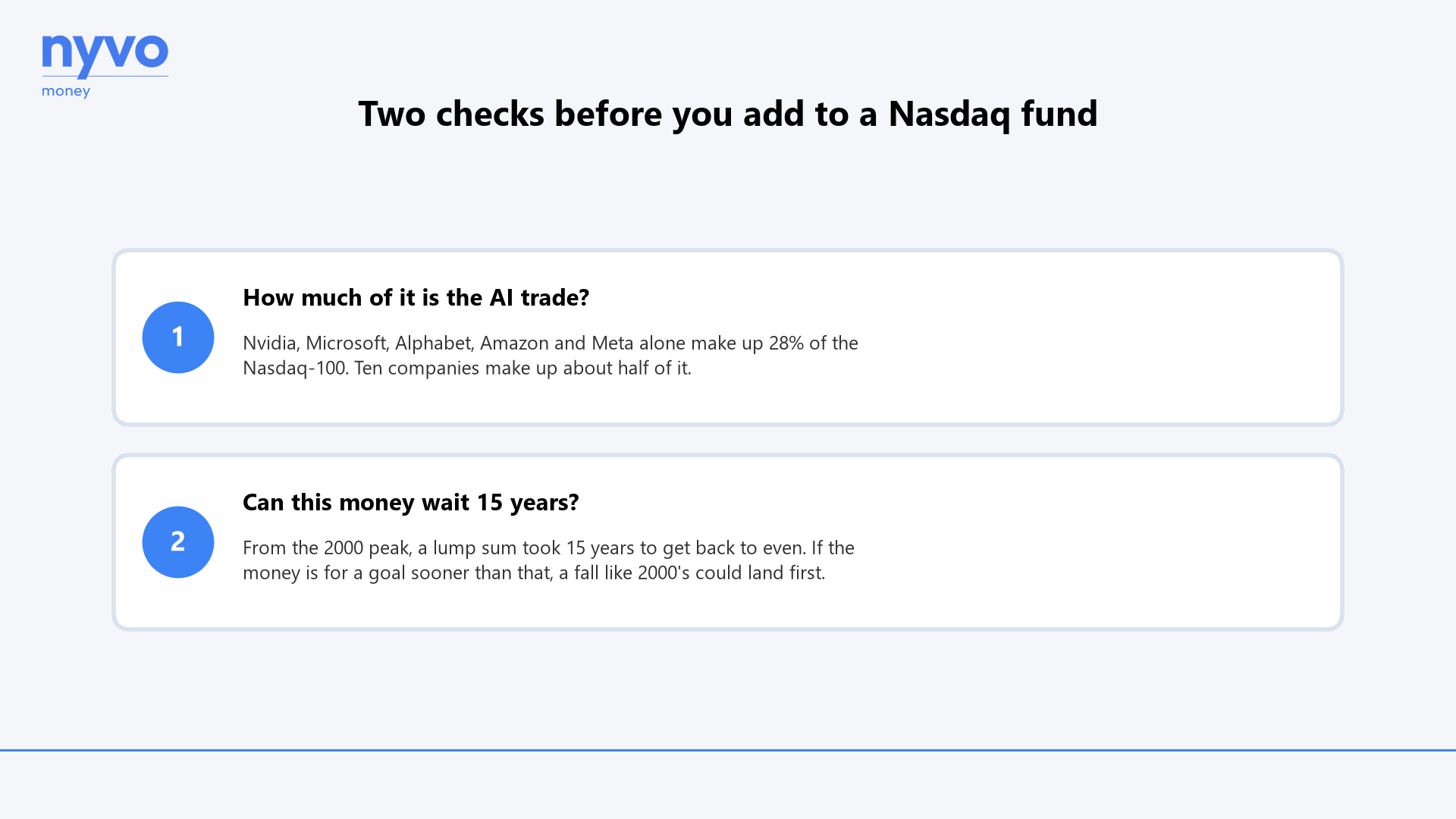
The lesson isn't to spot the top. It's to keep buying through the fall, and not need the money while you do.
The fund managers are asking when to get out. A household's question is whether it will ever be forced to.
Educational content, not investment advice. Companies and funds are named only to illustrate the point; what suits your household depends on your own goals, horizon and savings.
Now in the nyvo app
Plan it for real in the nyvo app.
Goals, projections, fund grades and your whole family's money – in one place. Free. SEBI-registered.
Tools to try
Run the numbers yourself.
Free calculators that go with this issue. Built for Indian rules (rupees, inflation, tax regime).
- SIP Calculator – Monthly Mutual Fund Returns India
Estimate the future value of a monthly mutual-fund SIP in India. Enter your amount, expected return and horizon to see the corpus and gain split.
- Lumpsum Calculator – One-Time Investment India
Estimate the future value of a one-time mutual-fund or fixed-income lumpsum in India. Enter principal, expected return and horizon to see the corpus.
Also worth reading

5 June 2026
International Mutual Funds Are Outperforming. But How Accessible Are They?
The best-performing route for Indian investors last year ran straight out of the country – through Taiwanese chips, US tech and global gold. The Nippon India Taiwan fund returned 195.7%. The catch: SEBI's overseas-investment cap means the door is half-shut.

29 May 2026
You can't lose with SIPs: if you stick around long enough
Across 29 years of Indian equity market history and 120 diversified funds, no 10-year SIP investor has ever ended in the red. Not low probability – zero. The maths is straightforward; the behaviour is the hard part.

8 October 2026
How game theory can help beat a falling market
The Nifty 50 is down 13.7% in 2026. Von Neumann's game theory explains why that is a discount for some investors and a trap for others.