Seven SIP myths, busted with real data

Indians put a record amount into SIPs in a bad month
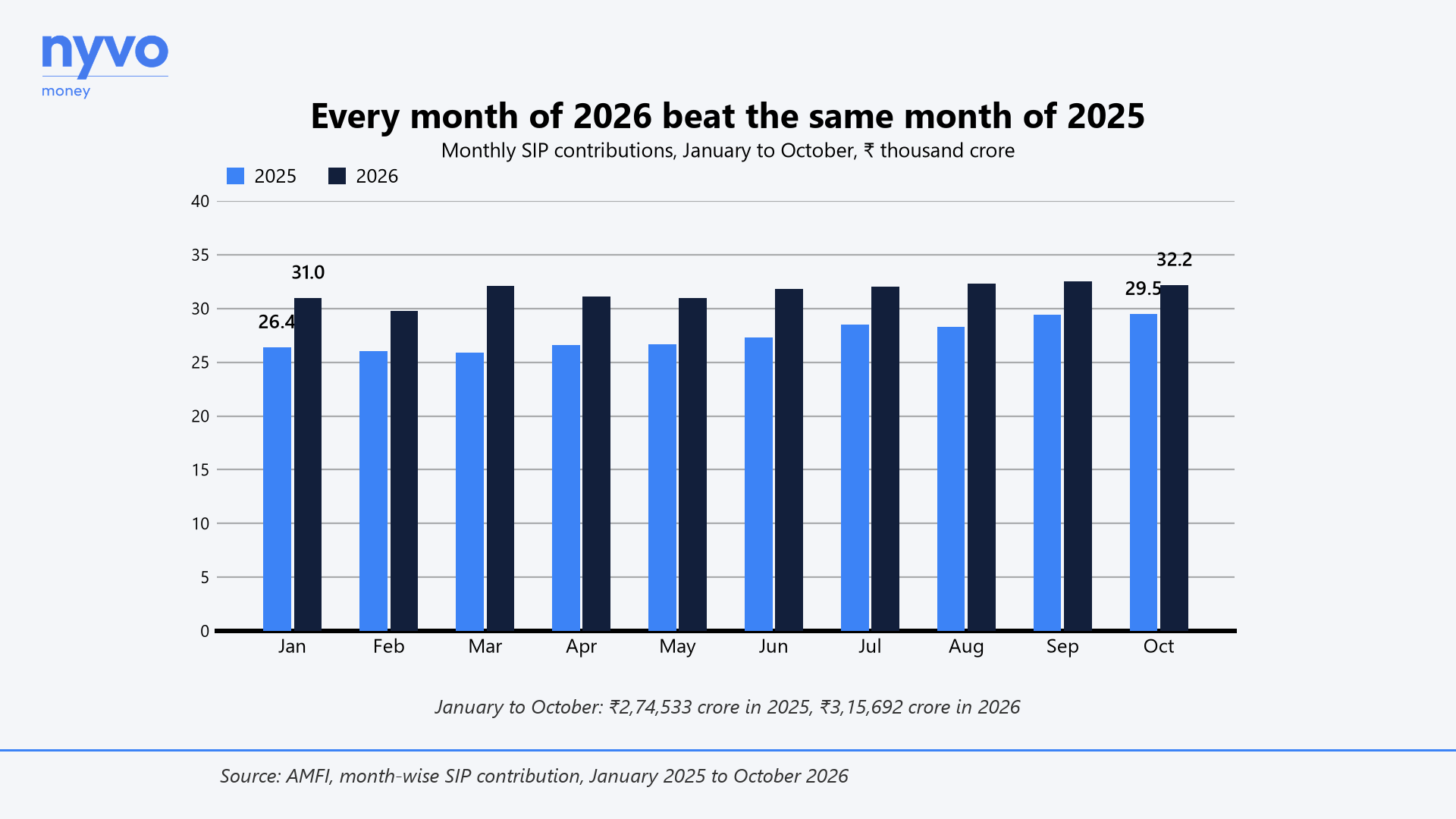
In September 2026 the Nifty 50 fell 6.06%. That same month, Indians put a record ₹32,490 crore into SIPs, on AMFI data.
From January to October, SIP money added up to ₹3,15,692 crore, 15.0% more than in the same ten months of 2025.
Take a salaried household that started a ₹10,000 monthly SIP in a Nifty 50 index fund in January 2025. Here are seven common SIP myths, checked against its numbers and 13 years of the same fund's data.
Myth 1: A SIP cannot lose money
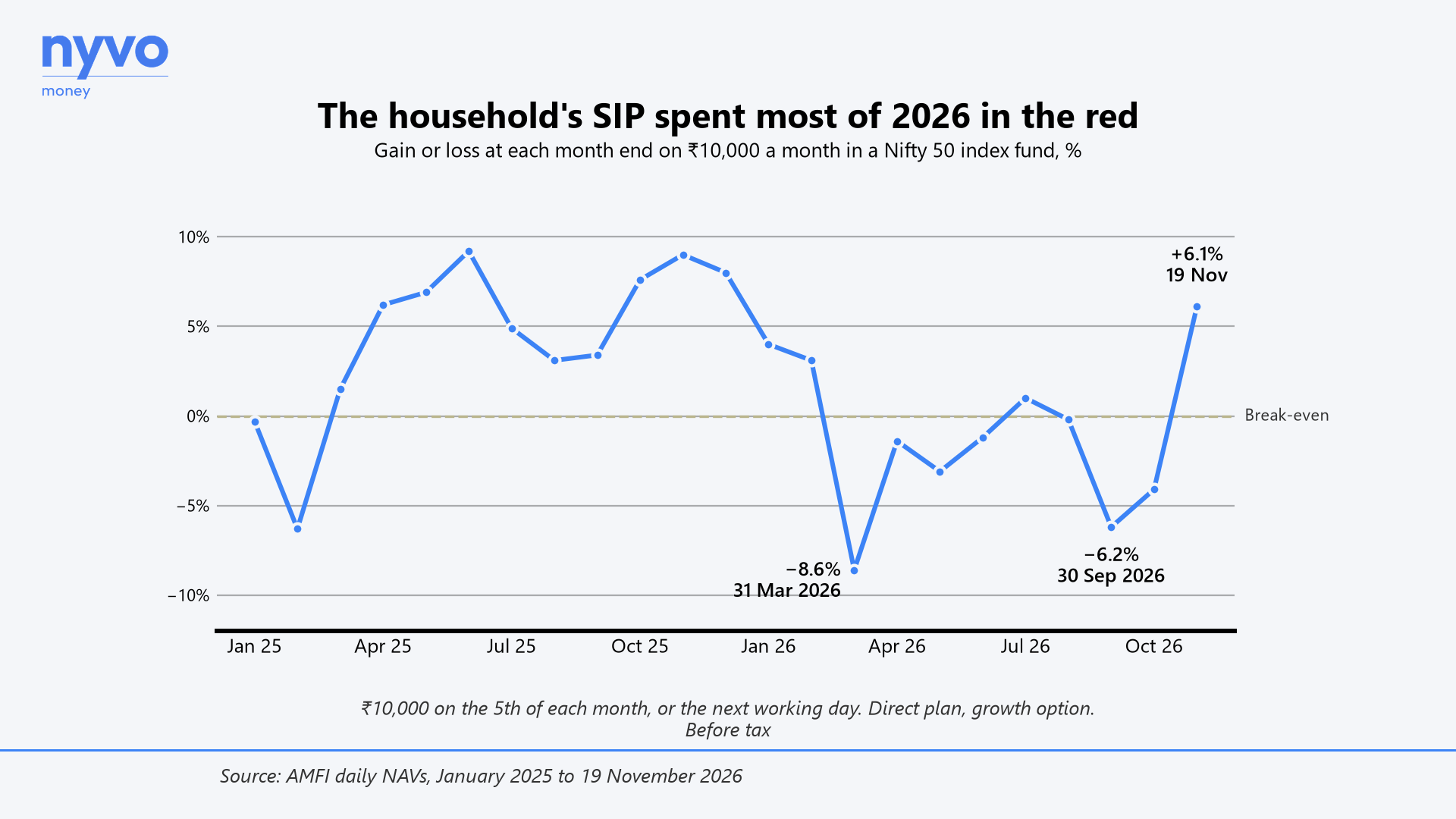
The household's SIP was worth less than it had put in at seven of the ten month ends in 2026.
On 30 September, after 21 instalments, ₹2.1 lakh was worth ₹1,96,931, down 6.2%. By 19 November, ₹2.3 lakh was worth ₹2,43,964, up 6.1%.
What matters most is time. Since 2013, 30 of 154 one-year SIPs in the same fund ended with a loss. Over three years it was 4 of 130, and over five years 2 of 106.
None of the 82 seven-year SIPs lost money, and none of the 46 ten-year ones. The weakest ten-year SIP still ended 66.5% above what went in. That is history, not a guarantee, but it shows where the risk sits: in the short run.
A SIP spreads out the dates you buy on. It does not take away the risk in what you buy.
A SIP into a fund that holds only shares carries the full risk of shares. What cushions the falls is diversification: spreading money across shares, bonds and gold, which rarely all fall together.
Myth 2: A SIP locks your money in
You can stop a SIP or sell its units at any time, except in a tax-saving ELSS fund.
In an ELSS, each instalment is locked in for three years from its own date. Other funds may charge an exit fee on early sales.
Missing a payment does not end the SIP either. Under SEBI rules, a monthly SIP stops only after three consecutive instalments fail, on AMFI's note. The units already bought stay invested.
Myth 3: You should stop your SIP when the market falls
The instalments made during the fall are the ones doing best.
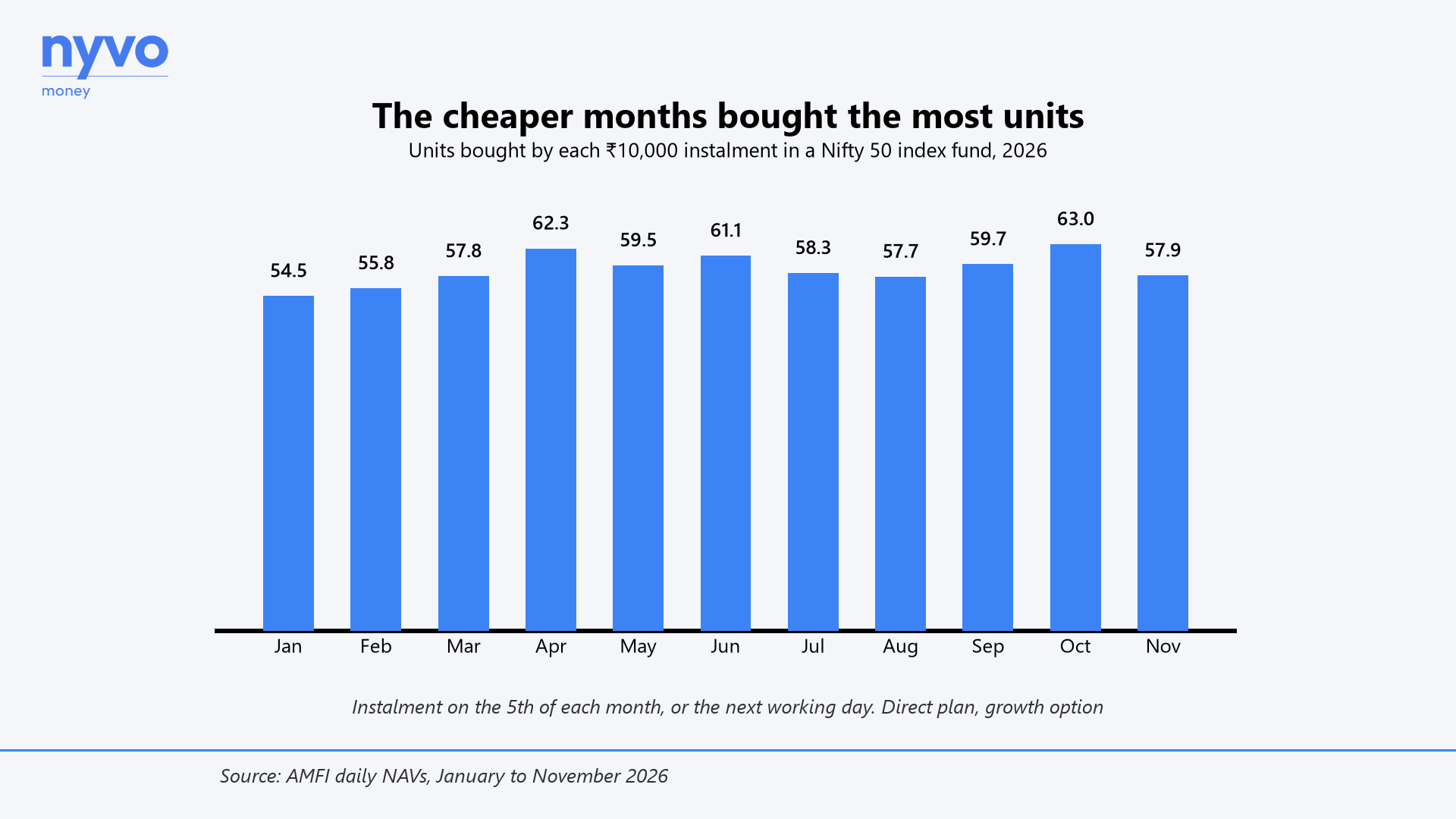
On 5 January 2026, ₹10,000 bought 54.53 units. On 5 October it bought 62.96, 15.5% more. The household's six instalments from April to September 2026 are now up 7.4%. Its other 17 are up 5.6%. Pausing in April would have skipped its best buys.
Most Indians kept paying through the fall.
SIP accounts that paid an instalment rose from 964.91 lakh in April to 1,006.47 lakh in September. October did see 59.12 lakh SIPs end and 50.68 lakh start, but AMFI's count of ended SIPs includes SIPs that ran their full term and SIPs cancelled after missed instalments.
Some people did stop: accounts paying an instalment fell by 6.6 lakh in October, the first drop since May.
Two catches. Cheap units only pay off if the market recovers, and after 2008 the Nifty 50 took 32.8 months to get back.
And if a job loss means the instalment would come out of the emergency fund, pausing is the sensible call.
The rule is not "never stop". It is "do not stop because prices fell".
Myth 4: Picking the right SIP date earns more
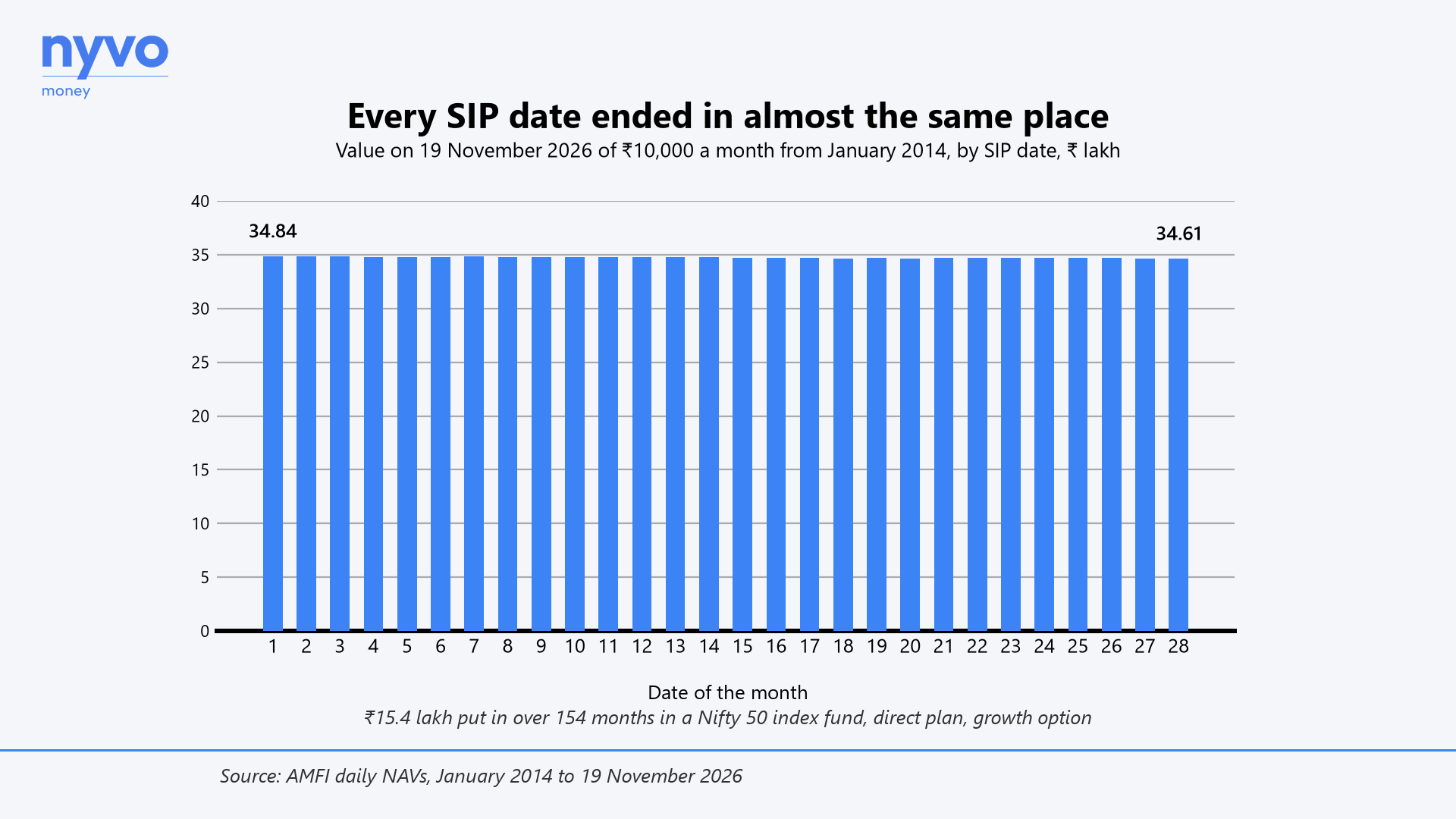
Over 13 years, the date barely mattered.
A ₹10,000 SIP from January 2014 to October 2026 put in ₹15.4 lakh. Across every date from the 1st to the 28th, it ended worth between ₹34.61 lakh and ₹34.84 lakh on 19 November 2026. The best date beat the worst by ₹22,740, or 0.7%.
The date that does matter is the one a few days after salary comes in. A debit that bounces costs a missed instalment, and three in a row end the SIP.
Myth 5: Daily or weekly SIPs beat monthly ones
Splitting the same ₹10,000 into smaller pieces made almost no difference.
Over the same 13 years, a monthly SIP ended at ₹34,79,143. Spread across each week it ended at ₹34,76,082, and across every trading day at ₹34,72,495.
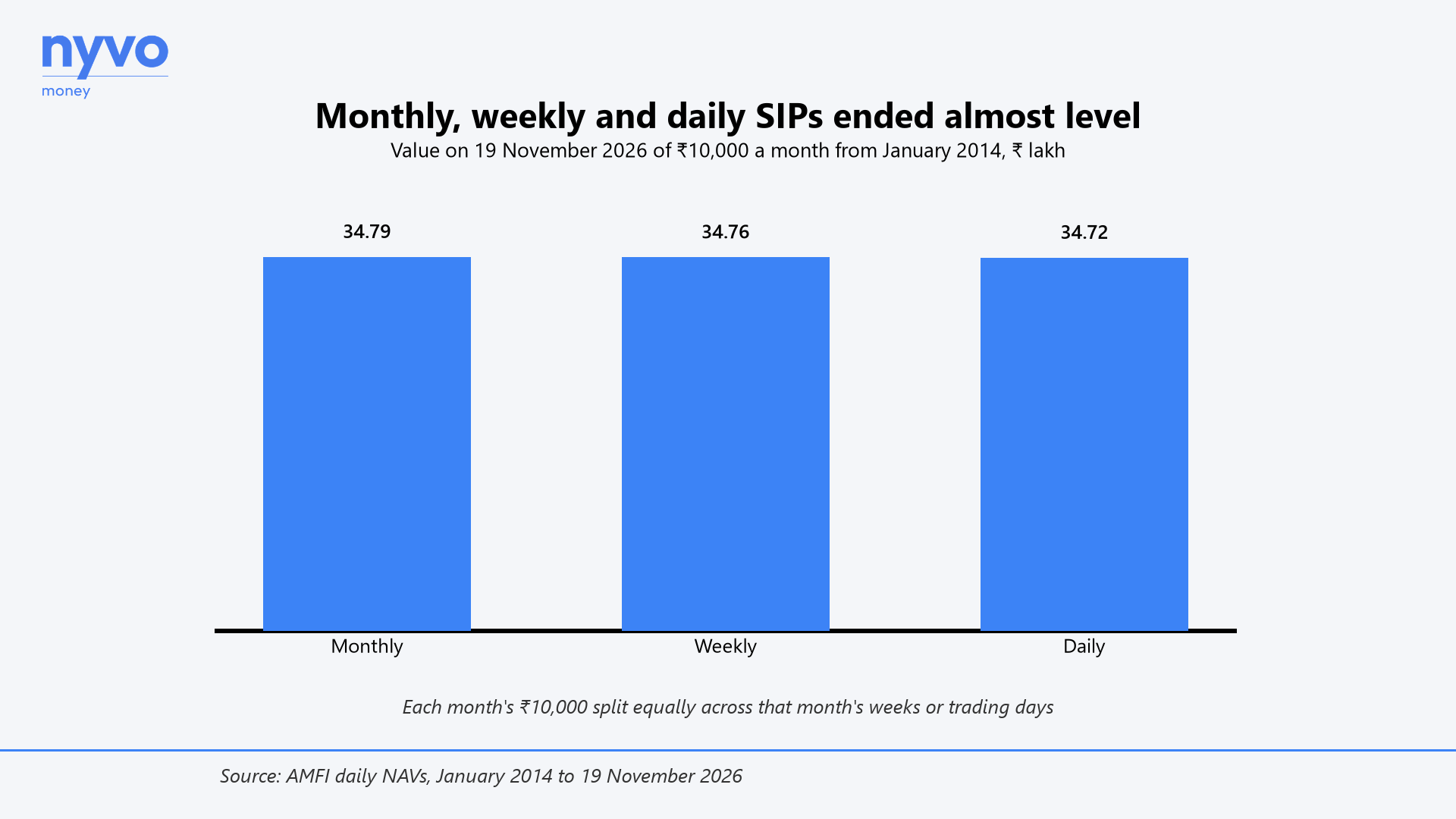
Monthly finished slightly ahead. The differences are small enough to be noise, so the right frequency is the one that matches when the money arrives. More frequent instalments mainly add more transactions to track.
Myth 6: A SIP always beats investing a lump sum
If you already have the money, investing it at once has usually done better.
Say the household gets a ₹1.2 lakh bonus. It can invest all of it on day one, or put in ₹10,000 a month for a year. We checked both for every start month from February 2013 to October 2025, and compared them 12 months after the start.
The lump sum ended ahead in 117 of 153 periods, 76% of them, by a median of 5.5%. In January 2025, the household's own start month, ₹1.2 lakh at once was worth ₹1,34,793 a year later. The SIP route was worth ₹1,30,146.
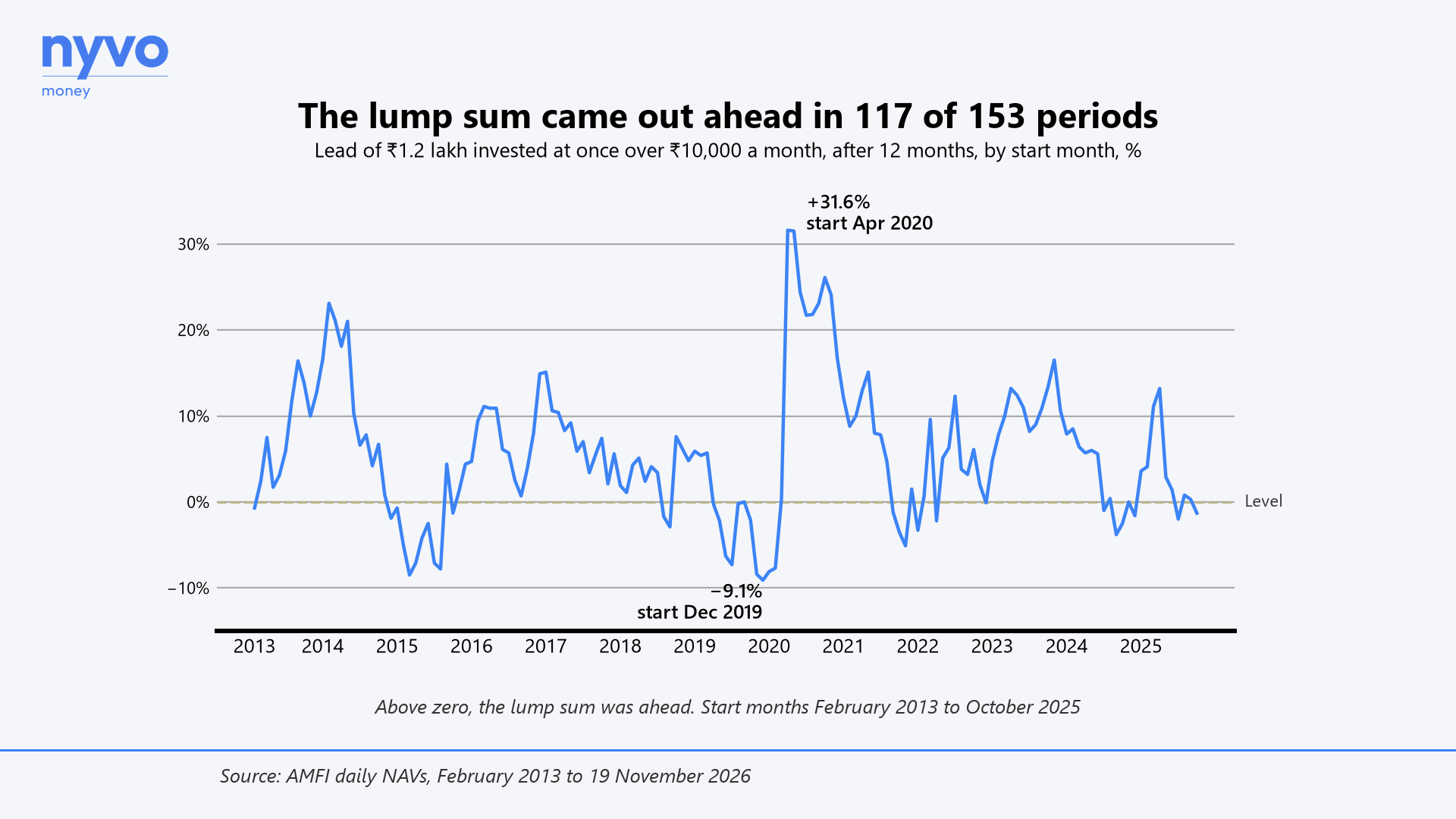
The reason is time in the market. A lump sum is invested for all 12 months. In a SIP, the last ₹10,000 goes in with one month left, so on average the money is invested for only about half the year. When the market rises, as it does more often than not, the money that waited earns less.
The lump sum loses when the market falls soon after it goes in. ₹1.2 lakh put in on 5 December 2019, just before the Covid crash, was worth ₹1,34,100 a year later. The SIP route was worth ₹1,47,459, because its instalments bought during the fall.
So a SIP is not the higher-return choice. What it protects against is one specific bad outcome: putting everything in just before a fall. It does not help if the fall comes late. A ₹1.2 lakh SIP started in April 2019 lost 23.8% by April 2020, almost exactly what the lump sum lost.
That is why fund houses offer an STP, a systematic transfer plan, for one-off sums like a bonus. The money waits in a liquid fund earning interest and moves into equity a month at a time. It costs some return on average, in exchange for less regret if the timing turns out badly. For money that arrives monthly, like a salary, a SIP is simply how it gets invested.
In this comparison the money waiting for the SIP earns nothing, which slightly favours the lump sum. An STP's liquid fund would narrow that gap.
Myth 7: After a year, the whole SIP counts as long term
Each instalment has its own clock.
Equity fund units count as long term for tax only after 12 months, and the oldest units are treated as sold first.
On 19 November 2026, the household's 11 instalments from 2025 up to November were long term, worth ₹1,17,750. The 12 from December 2025 onwards, worth ₹1,26,214, were still short term.
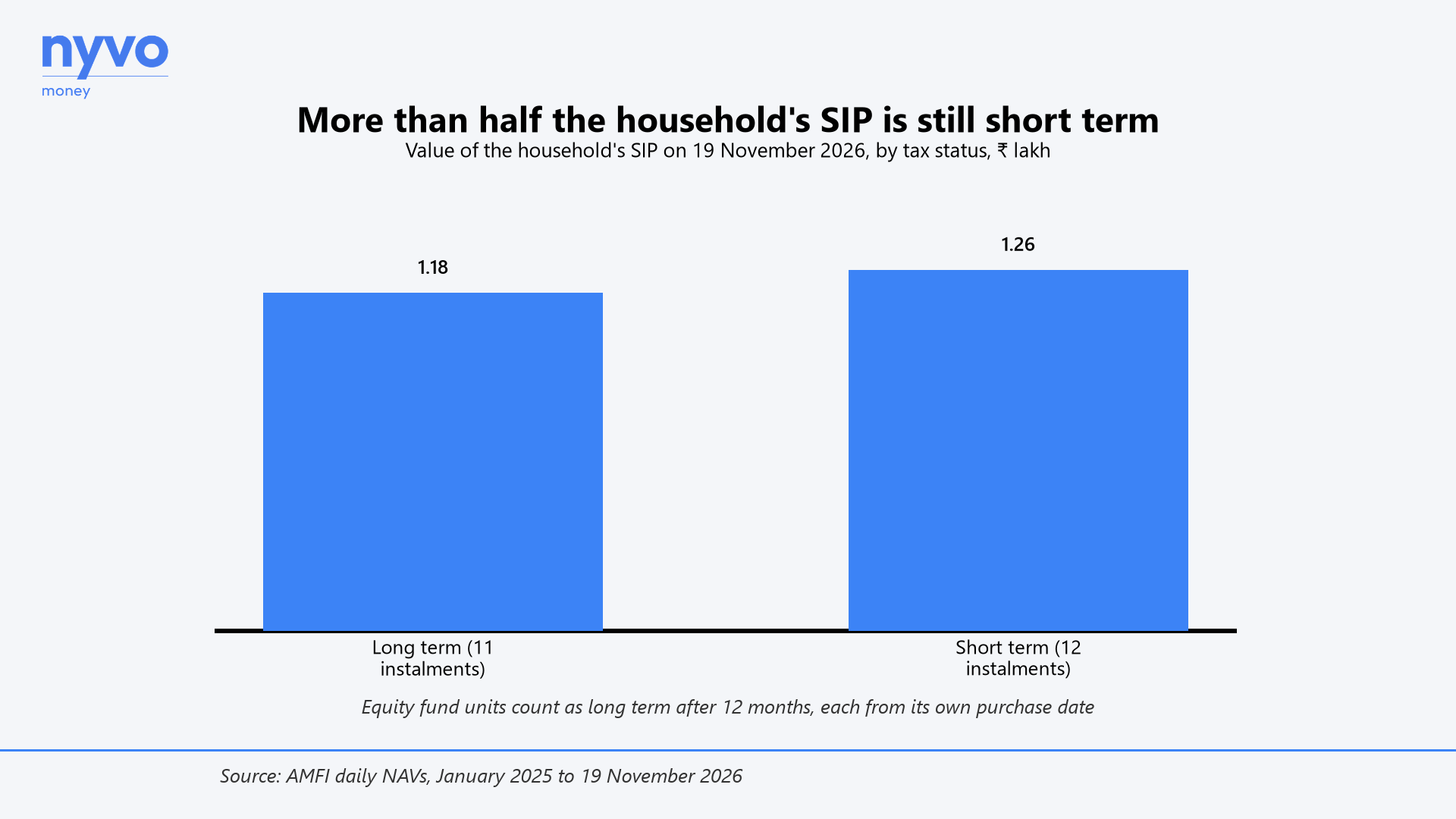
Short-term gains on equity funds are taxed at a higher rate, so selling recent units early costs more than the gain suggests.
What the seven myths mean for the household
Twenty-three instalments in, the household has put in ₹2.3 lakh and holds ₹2.44 lakh.
Most of what it was told about SIPs was about timing: the date, the frequency, when to pause. Over 13 years, none of that moved the result by more than 0.7%. What moved it was the market, and whether the instalments kept going.
A SIP decides how you buy. The market still decides what it is worth.
Published for information only. Nothing here is investment advice or a recommendation to buy, sell or hold. The household's SIP and the 13-year comparisons are calculations from the published daily NAVs of one Nifty 50 index fund, direct plan, growth option. They include fund costs and exclude tax and exit loads. SIP figures are AMFI industry data. Past performance is not a guide to future returns. Speak to a registered adviser before acting.
Now in the nyvo app
Plan it for real in the nyvo app.
One view of the whole family's money, with goals and a month-by-month SIP plan. Free to download. SEBI-registered Investment Adviser.


Tools to try
Run the numbers yourself.
Free calculators that go with this issue. Built for Indian rules (rupees, inflation, tax regime).
- SIP Calculator – Monthly Mutual Fund Returns India
Estimate the future value of a monthly mutual-fund SIP in India. Enter your amount, expected return and horizon to see the corpus and gain split.
- Lumpsum Calculator – One-Time Investment India
Estimate the future value of a one-time mutual-fund or fixed-income lumpsum in India. Enter principal, expected return and horizon to see the corpus.
- Mutual Fund Tax Calculator India – Equity, Debt & Gold Rules
Capital-gains tax on a mutual fund sale under current rules: 20% / 12.5% on equity with the ₹1.25 lakh exemption, slab rate on post-2023 debt.
Also worth reading

29 May 2026
You can't lose with SIPs: if you stick around long enough
Across 29 years of Indian equity market history and 120 diversified funds, no 10-year SIP investor has ever ended in the red. Not low probability – zero. The maths is straightforward; the behaviour is the hard part.

13 November 2026
Foreign investors are buying Indian shares again. Who is selling to them?
Foreign investors put ₹75,392 crore into Indian shares by 12 November 2026, a record. Why are FIIs buying Indian stocks, and who is selling to them?

6 November 2026
Why did India hold up when global tech stocks fell?
Korea's Kospi fell 8.8% on 6 November 2026 while the Nifty barely moved. Why the Indian stock market held up in the AI sell-off, and what could end it.