Foreign investors are buying Indian shares again. Who is selling to them?

Foreign investors bought a record amount in November
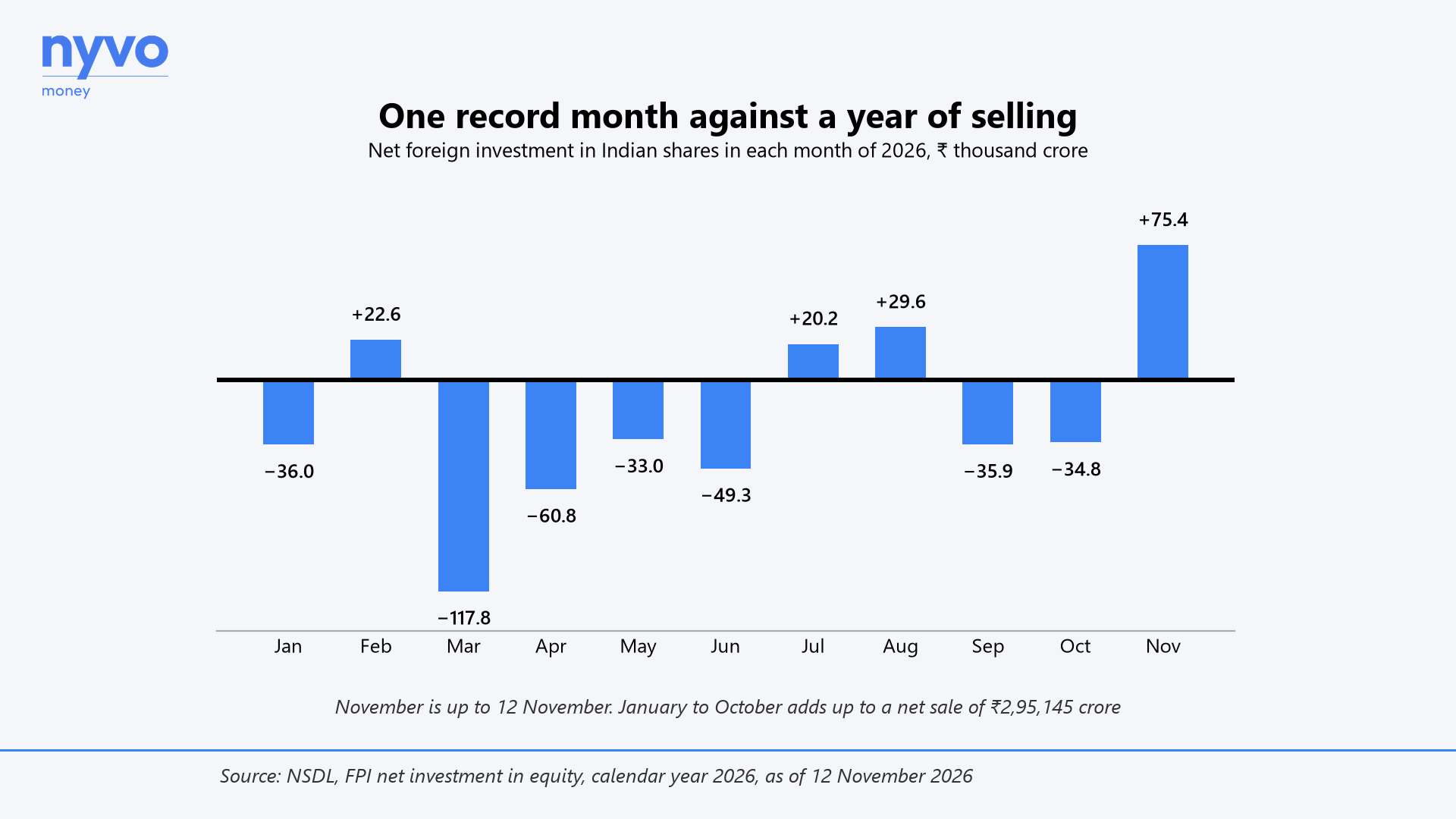
By 12 November 2026, foreign investors had put a net ₹75,392 crore into Indian shares this month, on NSDL data.
No full month in NSDL's records, which go back to 2002, has seen more. The previous high was ₹66,135 crore, in December 2023. The Nifty 50 closed at 25,299.35 on 12 November, up 9.7% from 30 October. Think of a family that puts ₹10,000 into a Nifty index fund at the end of every month. Every headline they read says foreign money is back.
Why FIIs are buying Indian stocks now
Three things changed in one week.
On 3 November, President Trump's Republicans lost both houses of the US Congress, and investors began to doubt that spending on AI data centres would keep growing. On 5 November the three main US indices had their worst day since April 2025, and money left chip-heavy markets such as Korea. Brent crude, above $114 around 23 October, closed at $97.75 on 6 November. India imports most of its oil, and the Nifty 50 has no chipmaker in it, so India gained both ways.
Does record foreign buying mean you should invest more?
The easy conclusion is that the professionals are back, so the family should add money too.
The numbers point the other way. From January to October 2026, foreign investors sold a net ₹2,95,145 crore of Indian shares. They were sellers in seven of those ten months. And a share cannot be bought unless someone sells it. So before following the foreign funds in, it is worth asking who sold them ₹75,392 crore of shares in under two weeks.
Indian institutions sold to them
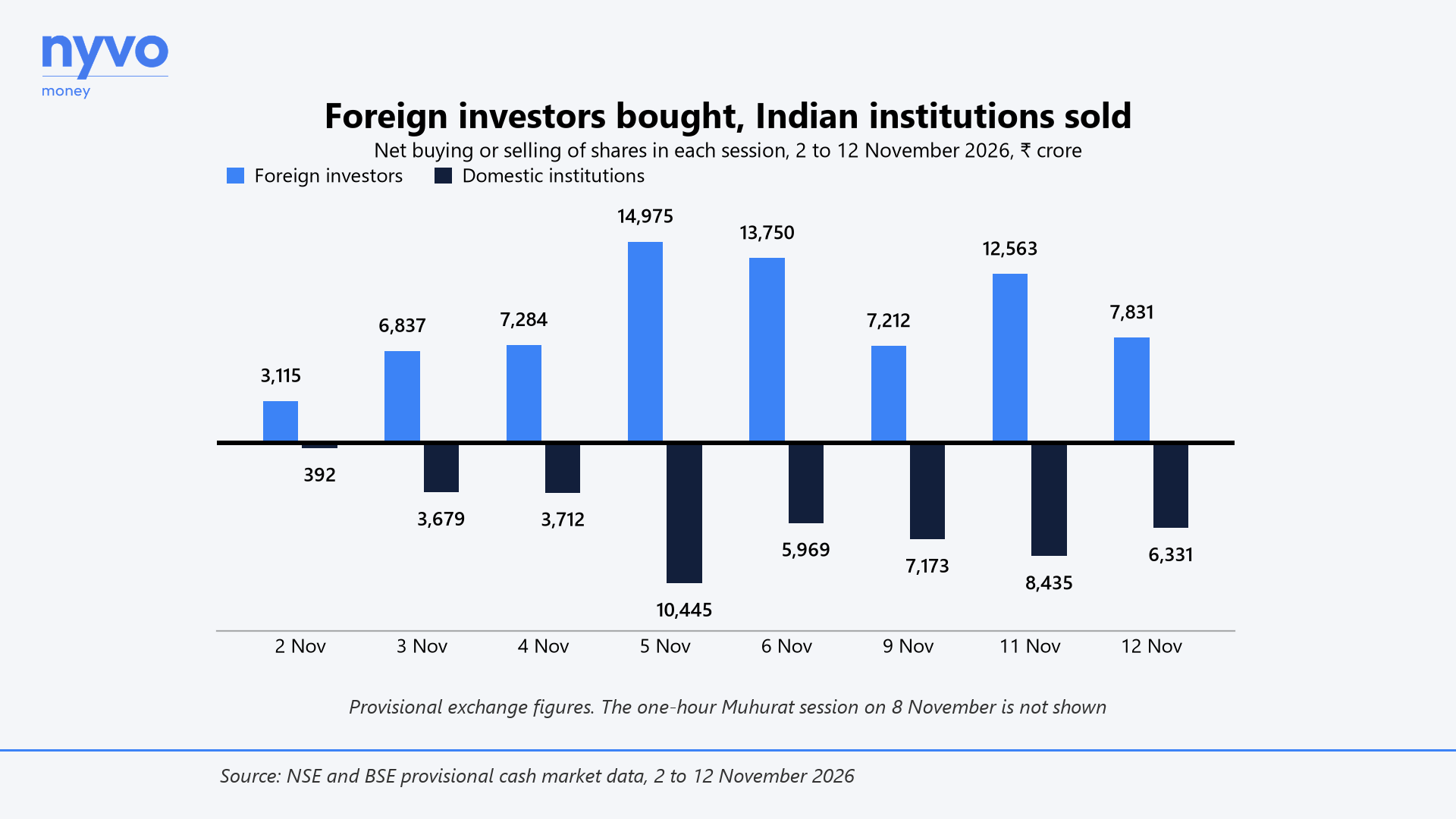
Between 2 and 12 November, domestic institutions sold a net ₹46,835 crore of shares on the stock exchanges.
These are Indian mutual funds, insurers, banks and pension funds. In the same sessions foreign investors bought a net ₹73,566 crore on the exchanges, so domestic institutions supplied about 64% of it. Everyone else, meaning individuals, companies and trading firms, supplied the rest. On 5 November alone domestic institutions sold ₹10,445 crore, their largest net sale in a single day on record.
The same institutions bought all year
Domestic institutions had been net buyers for 39 months in a row, from August 2023 to October 2026.
In March 2026, foreign investors sold ₹1,22,540 crore on the exchanges and domestic institutions bought ₹1,42,960 crore. In October they bought another ₹62,220 crore. Much of that money comes from households. SIP contributions alone were ₹32,160 crore in October, on AMFI data. So the family's ₹10,000 a month was part of what took the other side while foreign investors were leaving.
Why domestic institutions are selling now
The exchange figures do not say which institutions sold, or why.
SEBI's figures run only to 4 November. They show mutual funds selling a net ₹4,394 crore of shares in the first three sessions of the month. Kotak Securities calls the selling profit booking. Some of it is routine. A fund that holds a set mix of shares and bonds has to sell shares after a sharp rise to get back to that mix. None of this means SIP money stopped coming in.
Foreign investors have bought back a quarter of what they sold
November's ₹75,392 crore is 25.5% of what foreign investors sold from January to October.
Even after the record month, 2026 shows a net outflow of ₹2,19,753 crore, the largest for any calendar year in NSDL's data. Record buying has also reversed quickly before. December 2023 was followed by ₹25,744 crore of selling in January 2024. September 2024 brought ₹57,724 crore of buying. October 2024 brought ₹94,017 crore of selling.
Published for information only. Nothing here is investment advice or a recommendation to buy, sell or hold. The Nifty figures are index levels, which cannot be bought directly and exclude dividends, costs and tax. Foreign and domestic flow figures for November are provisional and cover part of the month. Past performance is not a guide to future returns. Speak to a registered adviser before acting.
Now in the nyvo app
Plan it for real in the nyvo app.
One view of the whole family's money, with goals and a month-by-month SIP plan. Free to download. SEBI-registered Investment Adviser.


Tools to try
Run the numbers yourself.
Free calculators that go with this issue. Built for Indian rules (rupees, inflation, tax regime).
- SIP Calculator – Monthly Mutual Fund Returns India
Estimate the future value of a monthly mutual-fund SIP in India. Enter your amount, expected return and horizon to see the corpus and gain split.
- Lumpsum Calculator – One-Time Investment India
Estimate the future value of a one-time mutual-fund or fixed-income lumpsum in India. Enter principal, expected return and horizon to see the corpus.
← Newer issue
Seven SIP myths, busted with real data
Older issue →
Why did India hold up when global tech stocks fell?
Also worth reading

6 November 2026
Why did India hold up when global tech stocks fell?
Korea's Kospi fell 8.8% on 6 November 2026 while the Nifty barely moved. Why the Indian stock market held up in the AI sell-off, and what could end it.

8 October 2026
How game theory can help beat a falling market
The Nifty 50 is down 13.7% in 2026. Von Neumann's game theory explains why that is a discount for some investors and a trap for others.

30 October 2026
The hybrid fund that barely changed its mix, and beat almost all its peers
How do balanced advantage funds work? 30 of 34 bought more stocks in the fall. The two that swung most lost 5–7% a year. The steadiest made 3.57%.